By Brian French | Florida Authority Network | October 2, 2026
Quick Answer
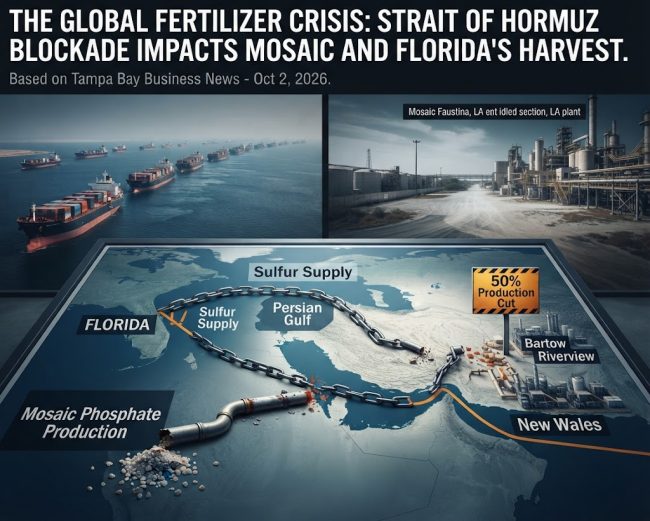
The Iran war closed most shipping through the Strait of Hormuz. That cut off nearly half the world’s seaborne sulfur, which is needed to make phosphate fertilizer. Tampa-based Mosaic, the largest U.S. phosphate producer, has scaled back output at its Florida and Louisiana plants. Farmers are using less fertilizer as a result, which puts 2026–2027 harvests and food prices at risk.
What Triggered the Fertilizer Price Shock?
Nitrogen fertilizer prices rose sharply after hostilities began between Iran, the United States, and Israel on February 28, 2026. An April 8 ceasefire was announced, but tanker traffic through the Strait of Hormuz stayed far below pre-war levels. After U.S.-Iran peace talks in Islamabad collapsed on April 12, a U.S. naval blockade took effect April 13 and commercial traffic remained badly restricted.
Fertilizer runs on this one shipping lane. The Persian Gulf normally supplies about 40% of the world’s traded urea and roughly 44% of seaborne sulfur, the key inputs for nitrogen and phosphate fertilizer.
How High Did Prices Go?
| Input | Pre-war | Peak 2026 |
|---|---|---|
| Urea (global) | ~$470/mt | $850+/mt (April) |
| Anhydrous ammonia (U.S.) | $828/ton | $1,114/ton (April) |
| Sulfur (spot) | ~$380/ton | ~$1,200/ton |
The World Bank reported urea above $850 per metric ton in April, up 80% since February and the highest since April 2022. Anhydrous ammonia had averaged $828 per ton from September 2025 through February 2026, then reached a national average of $1,114 per ton by mid-April.
Why Is Sulfur the Problem for Florida?
Phosphate fertilizer is made by treating phosphate rock with sulfuric acid, and sulfuric acid is made from sulfur. Sulfur accounts for roughly 70–80% of the cost of producing sulfuric acid. About four tons of sulfur go into every ten tons of phosphate fertilizer.
Florida mines the rock. The sulfur mostly comes from Gulf oil and gas refining, and nearly half of all global seaborne sulfur trade moves through the Strait, which makes the region the world’s price setter.
How Has Mosaic Responded?
Mosaic’s U.S. plants matter far beyond Florida. The company supplies over half of America’s annual phosphate crop nutrient needs.
Mosaic Curtailment Timeline
| Date | Action |
|---|---|
| Dec 2025 – Jan 2026 | Idled Brazil SSP plants (Fospar, Araxá) |
| May 11, 2026 | Cut Bartow, FL and Faustina, LA output ~50%; withdrew 2026 guidance |
| Aug 7, 2026 | Further cuts at Bartow, Riverview, Faustina, Uncle Sam |
| Sept 2026 | Uberaba, Brazil mothballing begins |
On May 11, Mosaic said it would cut phosphate production 50% at Faustina and Bartow and withdrew its 2026 phosphate production guidance after sulfur hit record levels. The withdrawn target had been seven million tonnes or more.
The cuts deepened over the summer. On the August 5 call, Louisiana was described as completely offline and Bartow as running near 40% of capacity, with New Wales and Riverview in the low-to-mid 70s. Mosaic told Argus the curtailments are a temporary response and not a change in long-term strategy.
The Financial Hit
The phosphate segment posted a $48 million first-quarter operating loss, compared with a $139 million operating profit a year earlier. Mosaic swung to a net loss in the second quarter as sulfur costs spiked. CEO Bruce Bodine said the economics of the phosphate industry “cannot accommodate current sulfur prices.”
The company also took $442 million in charges to indefinitely idle its high-cost Araxá and Patrocínio facilities in Brazil. To control costs, Mosaic locked in third-quarter sulfur at $705 per ton, well below spot prices.
Are Farmers Using Less Fertilizer?
Yes, and this is the core risk to the food supply. Nationally, about 70% of surveyed farmers said they could not afford all the fertilizer they needed. Farmers are moving acres from corn to soybeans, and wheat acreage is down six percent from 2025, a record low.
The same pattern is showing up globally. Farmers from Argentina to Europe are cutting nutrient use, switching to crops that need fewer inputs, or planting less. FAO data shows global fertilizer trade volumes fell 20–25% from January to April 2026 compared with a year earlier.
Is a Food Crisis Coming?
The situation is still in flux. There are serious warning signs, but there are also cushions.
The warning signs:
- FAO’s Director-General warned that fertilizer scarcity will lower yields and tighten food supplies in the second half of 2026 and into 2027.
- Bodine said global phosphate production could fall short of last year by up to 30 million tons.
- The FAO Food Price Index averaged 133.3 points in August, up 1.9% from July and 2.5% from a year earlier.
The cushions:
- In the first 161 days of the conflict, grain and oilseed prices rose an average of 11.6%, compared with 18.4% in the same period after Russia invaded Ukraine.
- Many U.S. farmers bought and applied part of their 2026 fertilizer before prices peaked.
- As of September 29, reports indicated Persian Gulf oil flows were nearing pre-war levels, pushing oil prices down.
- North American sulfur was about $0.32/kg in September, down 11.1%, though Northeast Asia was still at $1.23/kg.
The Lag Problem
Fertilizer shocks reach the grocery store late. The effects often show up months after prices rise, once farmers have planted with fewer nutrients, changed crops, or put off purchases. University of Illinois analysts said the 2027 fertilizer buying window may be more exposed than spring 2026, and sulfur tightness keeps phosphate prices high longer than nitrogen. Sulfur traders also expect prices to come down slowly even after the Strait reopens, because of cargo backlogs and damaged infrastructure.
What This Means for Florida
| Florida Impact | Why It Matters |
|---|---|
| Polk & Hillsborough plants | Bartow, Riverview, New Wales running below capacity |
| Jobs | ~4,400 Mosaic employees across FL and LA |
| Port Tampa Bay | Phosphate and sulfur are core cargo |
| Florida growers | Higher input costs for citrus, vegetables, sugarcane |
Mosaic’s Florida and Louisiana operations employ nearly 4,400 people plus 3,500 contractors.
Brian’s Take
Mosaic is Florida’s clearest window into this crisis. The rock is in Polk County, but the price of turning it into fertilizer is set in the Persian Gulf. Mosaic is holding capacity, not closing plants: management says it can return to full production within weeks once sulfur flows resume. That makes sulfur’s price, not phosphate demand, the number to watch.
The food story is a 2027 story. This year’s harvest was protected partly by fertilizer bought before the war. Next year’s harvest depends on what farmers can afford to buy this fall and winter. If Gulf flows keep normalizing and sulfur keeps easing, Mosaic’s restart will be one of the first Florida signals that the crisis is ending. Mosaic’s third-quarter earnings report will be the next major data point.
Frequently Asked Questions
Why did fertilizer prices skyrocket in 2026?
The Iran war that began February 28, 2026 shut most shipping through the Strait of Hormuz. The Persian Gulf supplies about 40% of traded urea and 44% of seaborne sulfur, so prices for nitrogen and phosphate fertilizer surged.
Why did Mosaic idle fertilizer production?
Sulfur is the main cost in making the sulfuric acid needed for phosphate fertilizer. With spot sulfur near $1,200 per ton, production lost money. Mosaic cut output at Bartow and Riverview in Florida and Faustina and Uncle Sam in Louisiana.
Where are Mosaic’s Florida plants?
Mosaic’s Florida phosphate operations include Bartow, Riverview, and New Wales in Central Florida’s Polk and Hillsborough counties. The company is headquartered in Tampa.
Will the fertilizer crisis raise food prices?
It could. FAO warns of lower yields in late 2026 and 2027 because farmers cut fertilizer use. So far, grain prices have risen less than in 2022 because global stocks were stronger going in.
When will fertilizer prices come down?
That depends on the Strait of Hormuz. Analysts expect nitrogen to ease first, while phosphate stays high longer because sulfur supply chains are slow to recover.
How much U.S. phosphate does Mosaic supply?
Mosaic supplies more than half of America’s annual phosphate crop nutrient needs.
Sources and Further Reading
- The Mosaic Company — Q1 2026 Earnings Release (Exhibit 99.1)
- Mosaic Investor Relations — Extension of Phosphate Production Curtailments in Brazil (Jan. 21, 2026)
- Michigan Farm News / Agri-Pulse — Mosaic to Cut U.S. Phosphate Production (May 2026)
- Argus Media — Mosaic to Further Curtail US, Brazil Phosphate Output (Aug. 2026)
- BigGo Finance — Mosaic Q2 2026 Earnings Call Summary
- Briefs — Sulfur Prices Are Crushing the Biggest U.S. Phosphate Maker
- Alliance Chemical — Sulfuric Acid Plant Curtailments 2026 (Sept. 17, 2026)
- farmdoc daily (University of Illinois) — Strait of Hormuz Disruption Scenarios and Fertilizer Purchasing Risks
- farmdoc daily — Middle East Ceasefire Fails to Ease U.S. Fertilizer Price Pressure
- World Bank Blogs — Fertilizer Prices Surge as Strait of Hormuz Disruptions Tighten Supplies (May 2026)
- FAO Newsroom — Strait of Hormuz Crisis: Fertilizer Scarcity Will Affect Next Harvests
- IFDC — Fertilizer Crisis Response Bulletin #30 (Sept. 22, 2026)
- Economist Impact — Beyond the Farm Gate: Lessons from the 2026 Fertiliser Shock
- World Grain — Fertilizer Costs Reaching Tipping Point
- S&P Global — Global Sulfur Prices Likely to React Slowly if Strait of Hormuz Reopens
- IMARC Group — Sulphur Price Trend, September 2026
- FreightWaves — More Oil Out of the Gulf Translating to Lower Prices (Sept. 29, 2026)
- U.S. EPA — Mosaic Fertilizer, LLC Settlement
- Federal Permitting Dashboard — Riverview East Stack Extension
About the Author