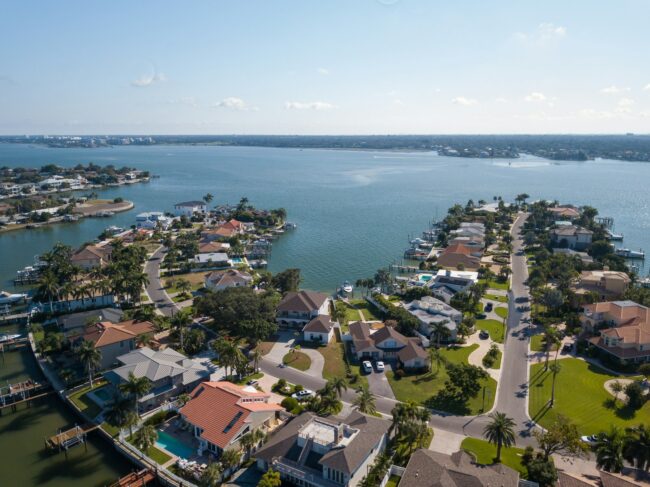
Aerial view of a waterfront neighborhood in Indian Rocks Beach, Pinellas County. Source: Matt Paul, via Unsplash. License: Unsplash License.
Quick Answer: Tampa-based Heritage Insurance Holdings earned $51.1 million, or $1.72 per diluted share, in the third quarter of 2026, up from $50.4 million a year earlier, even though it took $15.8 million in catastrophe losses. Gross premiums written fell 3.1% to $322.8 million, mostly because of price competition in Florida commercial residential coverage. The results come as Florida homeowners rates fall and Citizens Property Insurance keeps shrinking.
Heritage Insurance Holdings, Inc. (NYSE: HRTG), a Tampa-based property insurer, reported its third-quarter 2026 results on October 28, 2026. Profit edged up and book value per share grew 42.9% from a year earlier, even as premium volume slipped. The company’s release and the accompanying Form 8-K filed with the U.S. Securities and Exchange Commission show an insurer that is still very profitable. Lower reinsurance costs are carrying more of the load, while price competition is eating into its Florida commercial book.
The quarter is also a useful read on the wider Florida market, which matters to Tampa Bay homeowners and condominium associations from Hillsborough and Pinellas to Manatee, Sarasota and Polk counties. State regulators are approving a steady stream of homeowners rate decreases. Citizens Property Insurance Corporation, the state-backed insurer of last resort, is at its smallest in decades. More than 20 new companies have entered the state since the 2022 and 2023 legislative reforms.
How much did Heritage earn in the third quarter of 2026?
Net income for the three months ended September 30, 2026, was $51.1 million, up 1.4% from $50.4 million in the third quarter of 2025. Diluted earnings per share rose 5.5% to $1.72 from $1.63. Per-share earnings grew faster than net income because the share count fell after buybacks. Total revenue increased 3.2% to $219.2 million.
For the first nine months of 2026, net income was $149.3 million, up 15.8% from $128.9 million a year earlier, and diluted earnings per share rose 18.5% to $4.94. Nine-month revenue was $646.1 million, up 2.2%. Annualized return on equity was 35.1% for the quarter and 36.1% for the nine months. Both are well below the 49.2% and 47.2% of a year earlier, because equity has grown much faster than earnings.
| Metric | Q3 2026 | Q3 2025 | Change | 9M 2026 | 9M 2025 |
|---|---|---|---|---|---|
| Total revenue | $219.2M | $212.5M | +3.2% | $646.1M | $632.0M |
| Net income | $51.1M | $50.4M | +1.4% | $149.3M | $128.9M |
| Diluted EPS | $1.72 | $1.63 | +5.5% | $4.94 | $4.17 |
| Gross premiums written | $322.8M | $333.2M | -3.1% | $1,058.0M | $1,100.1M |
| Ceded premiums | $147.2M | $166.8M | -11.8% | $451.1M | $477.9M |
| Net premiums earned | $205.6M | $195.1M | +5.4% | $606.4M | $591.5M |
| Net investment income | $11.4M | $9.7M | +17.3% | $31.8M | $27.3M |
| Net loss ratio | 39.6% | 38.3% | +1.3 pts | 38.6% | 42.2% |
| Net expense ratio | 33.4% | 34.6% | -1.2 pts | 34.3% | 34.6% |
| Net combined ratio | 73.0% | 72.9% | +0.1 pts | 72.9% | 76.8% |
Source: Heritage Insurance Holdings third-quarter 2026 earnings release (Form 8-K, Exhibit 99.1).
What did the CEO say about the quarter?
Chief Executive Officer Ernie Garateix said in the release that the company had put in place “a strategy of long-term sustainability” several years ago. “Today, we are generating record earnings, producing substantial capital,” he said, adding that the company is “positioned well to continue our momentum into the future.”
Why did Heritage’s premiums decline?
Gross premiums written fell 3.1% to $322.8 million in the quarter. The company said this was “primarily reflecting lower commercial residential premiums, partially offset by growth in personal lines.” Over nine months, gross premiums written were $1.058 billion, down 3.8%. Gross premiums earned in the quarter fell 2.5% to $352.8 million.
Total premiums in force were $1.40 billion at September 30, 2026, down 2.8% from a year earlier. Heritage attributed the drop mainly to commercial residential premium reductions caused by competitive pricing. Commercial residential premiums in force fell 16.1% to $232.1 million, even though the number of commercial residential policies rose 5.7% to 3,228. That combination means the company is keeping or adding accounts but charging less for each one, a direct sign of softer pricing in that segment. Management described the pressure as centered on Florida commercial residential business, the line that covers condominium and apartment buildings.
How many policies does Heritage have in force?
| Segment (Sept. 30, 2026) | Policies | YoY | Premiums in force | YoY |
|---|---|---|---|---|
| Personal residential | 335,909 | -4.3% | $1,157.4M | +0.2% |
| Commercial residential | 3,228 | +5.7% | $232.1M | -16.1% |
| Other | 8,783 | -6.7% | $10.1M | +10.3% |
| Total | 347,920 | -4.2% | $1,399.7M | -2.8% |
Total insured value rose 1.7% to $371.4 billion. The quarterly release does not break out policies by state. It says only that “a reduction in Florida personal lines in-force premiums was more than offset by personal lines growth in other states.” At year-end 2025, Heritage had 357,275 policies in force, of which 123,437 were in Florida and 233,838 were in other states, according to its fourth-quarter 2025 release.
How did catastrophes and weather affect results?
The third quarter of 2026 brought $15.8 million of pre-tax catastrophe losses, compared with none in the third quarter of 2025. The release attributes $9.1 million to Hurricanes Lala and Lowell. The other $6.7 million came from other catastrophe weather events, mainly a late-September nor’easter. Counting non-catastrophe weather, net weather and catastrophe losses for the current accident quarter totaled $33.6 million, up from $13.8 million a year earlier.
Two things offset those losses. Favorable development on prior-year loss reserves was $14.0 million, compared with $5.0 million a year earlier, meaning claims from earlier years are costing less than the company had reserved for. The net expense ratio also improved by 1.2 points to 33.4%. As a result, the net combined ratio was 73.0%, essentially flat with 72.9% a year earlier, even with the heavier weather. Net losses and loss adjustment expenses for the quarter were $81.4 million, compared with $74.8 million.
How much is reinsurance saving Heritage?
Lower reinsurance costs explain much of the earnings picture. Ceded premiums, the portion of premium paid to reinsurers, fell 11.8% to $147.2 million in the quarter. The ceded premium ratio dropped to 41.7% from 46.1%. The company said its June 2026 catastrophe excess-of-loss program produced treaty-year expense savings of $63.2 million, with seven-twelfths recognized in 2026. Because Heritage is paying reinsurers less, net premiums earned rose 5.4% to $205.6 million even though gross premiums fell.
The trend is statewide. Florida’s Office of Insurance Regulation (OIR) said in its July 1, 2026, Property Insurance Stability Report that preliminary data from its 2026 reinsurance data call showed nearly half of participating insurers getting risk-adjusted pricing reductions of 15% to 25%. Citizens said in June that reinsurance rates had dropped nearly 30% over the previous year.
How strong is Heritage’s balance sheet?
Book value per share was $20.22 at September 30, 2026, up 42.9% from a year earlier and 23.4% from $16.39 at December 31, 2025. Stockholders’ equity rose to $599.1 million from $505.3 million at year-end 2025 and $437.3 million a year earlier. The debt-to-capital ratio fell to 10.5% from 15.3%. Cash and invested assets were about $1.4 billion, up 8.8% from year-end. Net investment income rose 17.3% to $11.4 million on the larger portfolio.
Heritage reported an accumulated other comprehensive loss of $33.2 million, net of tax, which it attributed to rising interest rates. The average duration of its fixed-income portfolio is 3.3 years. The effective tax rate was 24.5%, down from 26.2%.
Is Heritage buying back stock?
Yes. Heritage repurchased 100,000 shares for about $3.3 million in the third quarter and 1,101,508 shares for about $27.9 million so far in 2026. It had $34.1 million left under its current authorization, which expires December 31, 2026. The board has approved a new program of up to $50.0 million that runs through December 31, 2027, starting when the current one ends. Shares outstanding fell to 29,632,416 from 30,911,435 a year earlier.
| Company snapshot | Detail |
|---|---|
| Company | Heritage Insurance Holdings, Inc. (NYSE: HRTG) |
| Headquarters | Tampa, Florida |
| Business | Super-regional personal and commercial residential property insurer |
| Footprint | Admitted business in the Northeast, Southeast and Hawaii; excess and surplus lines in California, Florida, Hawaii, South Carolina and Texas |
| CEO | Ernie Garateix |
| Premiums in force (9/30/26) | $1.40 billion |
| Policies in force (9/30/26) | 347,920 |
| Full-year 2025 net income | $195.6 million ($6.32 per diluted share) |
| Stockholders’ equity (9/30/26) | $599.1 million |
Where is Heritage growing outside Florida?
The release describes a footprint of admitted business in the Northeast, Southeast and Hawaii. It also writes excess and surplus (E&S) lines premium in California, Florida, Hawaii, South Carolina and Texas. The company highlighted its entry into Texas on an E&S basis as a recent expansion step. Heritage’s year-end 2025 release said it wrote about $1.4 billion of gross personal and commercial residential premium across that multi-state footprint. At the end of 2025, its policies outside Florida outnumbered its Florida policies by nearly two to one.
For the full year 2025, Heritage reported net income of $195.6 million, up 217.8% from $61.5 million in 2024. Total revenue was $847.3 million and the net combined ratio was 73.1%, compared with 94.2% in 2024.
What is happening in Florida’s homeowners insurance market?
Heritage’s falling Florida commercial pricing matches what state regulators are reporting across the residential market. In a September 22, 2026, release, OIR said 48 companies had filed for rate decreases and 53 had requested no change or a 0% increase since January 2024. It said the 30-day average homeowners rate request was -4.8%, compared with -1.1% a year earlier and +5.2% five years earlier. For comparison, it said the average approved rate in July 2022 was +15.33%. Insurance Commissioner Mike Yaworsky called it “the latest wave of significant rate decreases for Floridians.”
On October 29, 2026, OIR said more than 824,300 Florida homeowners would see decreases on new or renewal policies effective that month, with cuts of up to 12.1%. It said about 450,000 more were slated for decreases in November, December and January. “We are not taking the foot off the gas,” Yaworsky said in that release.
OIR’s July 2026 stability report said 21 new companies had been approved to write residential property coverage since the 2022 and 2023 reforms. It reported a pooled combined ratio of 83% for domestic insurers in 2025, the lowest in more than a decade. Of claims closed in 2025, 12.10% were litigated statewide.
How small has Citizens become in Tampa Bay?
Citizens Property Insurance Corporation reported 216,447 policies in force at October 31, 2026, and 215,397 as of November 6, 2026. Citizens said in June 2026 that its policy count had fallen from a peak of 1.4 million in late 2023. Its personal residential multiperil account held 168,941 policies statewide at October 31, down 27,376 from the month before.
Citizens’ October 31 county report shows the five Tampa Bay counties together had 30,457 personal residential multiperil policies. That total was down 5,513 in a single month.
| County | Citizens PR-M policies (10/31/26) | Change vs. prior month | Total exposure |
|---|---|---|---|
| Pinellas | 15,261 | -1,797 | $2.88B |
| Hillsborough | 4,293 | -1,035 | $893M |
| Manatee | 3,966 | -749 | $552M |
| Polk | 3,500 | -1,333 | $449M |
| Sarasota | 3,437 | -599 | $574M |
| Statewide | 168,941 | -27,376 | $25.5B |
Source: Citizens Property Insurance Corporation, policies in force detail by county, personal residential multiperil account, as of October 31, 2026. Excludes wind-only and commercial accounts.
Pinellas, with its long stretch of coastline, accounts for half of the Tampa Bay total.
What does the quarter mean for Tampa Bay?
For Tampa Bay, the numbers point in two directions. For property owners, falling reinsurance costs, approved rate decreases and the arrival of new carriers mean more choices and, in many cases, lower premiums. Heritage’s 16.1% drop in commercial residential premiums in force, alongside a rise in policy count, shows that condominium and apartment buildings are getting better prices from competing carriers.
For a Tampa-based insurer, the same trends squeeze revenue even as profits stay high. Heritage has offset lower Florida pricing with reinsurance savings, growth in other states, investment income and share repurchases. The company has not issued numerical guidance. Its third-quarter release frames the strategy around underwriting discipline in competitive markets and continued geographic diversification.
Frequently Asked Questions
When did Heritage report third-quarter 2026 results?
Heritage released results on October 28, 2026, from Tampa and furnished the release to the SEC on Form 8-K. It held a conference call on October 29, 2026.
What was Heritage’s combined ratio?
The net combined ratio was 73.0% in the third quarter of 2026, compared with 72.9% a year earlier. For the first nine months it improved to 72.9% from 76.8%.
Which storms caused Heritage’s third-quarter catastrophe losses?
The company reported $15.8 million of pre-tax catastrophe losses: $9.1 million from Hurricanes Lala and Lowell and $6.7 million from other events, primarily a late-September nor’easter.
Why are Heritage’s commercial premiums falling?
Heritage attributed the decline to competitive pricing pressure in commercial residential business. Premiums in force in that segment fell 16.1% while its policy count rose 5.7%.
How many Citizens policies are in Tampa Bay counties?
As of October 31, 2026, Hillsborough, Pinellas, Manatee, Sarasota and Polk counties together had 30,457 Citizens personal residential multiperil policies. More than half were in Pinellas.
Are Florida homeowners insurance rates falling?
According to OIR, 48 companies have filed for decreases since January 2024. In October 2026, more than 824,300 homeowners saw decreases of up to 12.1% on new or renewal policies.
Sources and Further Reading
- Heritage Reports Third Quarter 2026 Results, Form 8-K Exhibit 99.1 — Heritage Insurance Holdings, Inc. / U.S. Securities and Exchange Commission
- Heritage Reports Fourth Quarter and Full Year 2025 Results — Heritage Insurance Holdings, Inc.
- Commissioner Mike Yaworsky Approves Significant Rate Decreases for Homeowners (September 22, 2026) — Florida Office of Insurance Regulation
- Commissioner Mike Yaworsky and Chief Financial Officer Blaise Ingoglia Highlight Major Rate Decreases for Homeowners Effective This Month (October 29, 2026) — Florida Office of Insurance Regulation
- Property Insurance Stability Report, July 1, 2026 — Florida Office of Insurance Regulation
- Policies in Force and Detail by County, October 31, 2026 — Citizens Property Insurance Corporation
- Smaller Citizens Secures Coverage for 2026 Hurricane Season (June 23, 2026) — Citizens Property Insurance Corporation
About the Author