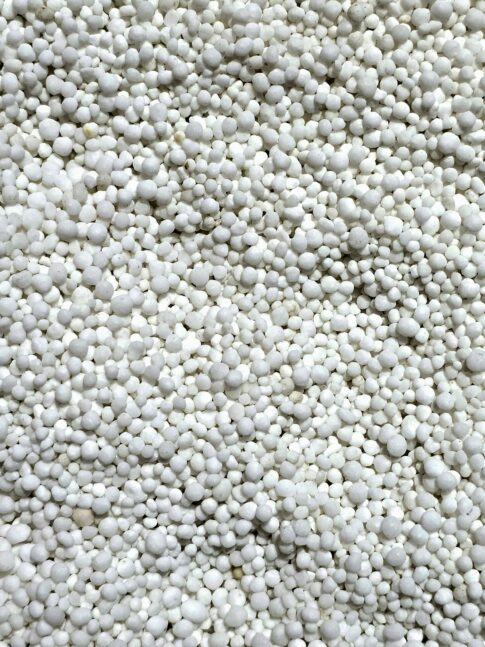
Granular fertilizer, the end product of the phosphate supply chain (illustrative). Source: Kenneth Berrios Alvarez, via Unsplash. License: Unsplash License.
Quick Answer: Tampa-based The Mosaic Company reported third-quarter 2026 revenue of $3.1 billion and a net loss of $72 million, compared with net income of $411 million a year earlier, as sulfur averaging $715 per long ton squeezed its phosphate business. For Tampa Bay, the most direct effect is in Polk County: Mosaic told the state it will idle South Fort Meade on December 8, affecting about 199 employees.
The Mosaic Company, the phosphate and potash fertilizer producer headquartered in Tampa, released its third-quarter 2026 results on November 3, 2026, and held its earnings call the next morning. The numbers show a company whose potash business is holding steady while its phosphate business, which is centered on mines and plants in Polk, Hillsborough and Manatee counties, is losing money on every tonne it sells because of sulfur costs.
Figures below come from the earnings release Mosaic filed with the U.S. Securities and Exchange Commission, company facility pages and a state layoff notice.
How did Mosaic perform in the third quarter of 2026?
Mosaic reported net sales of $3.1 billion for the quarter ended September 30, 2026, down from $3.45 billion in the third quarter of 2025. The company posted an operating loss of $97 million and a net loss attributable to Mosaic of $72 million, or $0.23 per diluted share. A year earlier it earned $411 million, or $1.29 per diluted share.
Adjusted earnings per share, which exclude what Mosaic calls notable items, were a loss of $0.19, compared with adjusted earnings of $1.04 per share in the prior-year quarter. Notable items totaled $53 million before taxes and mainly reflected environmental reserve adjustments and facility closure and restructuring costs, partly offset by a mark-to-market gain on Mosaic’s investment in Ma’aden.
Adjusted EBITDA, a measure of operating cash earnings, fell to $324 million from $806 million a year earlier. Cash from operations improved to $284 million, up from $228.5 million in the third quarter of 2025. Free cash flow was roughly breakeven. For the first nine months of 2026, Mosaic reported net sales of $8.92 billion and a net loss attributable to the company of $602.5 million.
| Consolidated measure | Q3 2026 | Q3 2025 |
|---|---|---|
| Net sales | $3.1 billion | $3.45 billion |
| Net income (loss) attributable to Mosaic | ($72 million) | $411 million |
| Diluted EPS | ($0.23) | $1.29 |
| Adjusted EPS | ($0.19) | $1.04 |
| Adjusted EBITDA | $324 million | $806 million |
| Cash from operations | $284 million | $228.5 million |
| SG&A expense | $124.4 million | $125.5 million |
President and CEO Bruce Bodine said in the release that the company “aligned phosphate production with the availability of affordable sulfur, reduced costs,” and strengthened its financial position. “These actions position us to deliver stronger performance as conditions improve,” he said.
Why did Mosaic’s phosphate business lose money?
The Phosphate segment is the part of Mosaic most tied to Tampa Bay. It mines phosphate rock in Central Florida and turns it into finished fertilizer at plants in Polk and Hillsborough counties. In the third quarter, the segment had an operating loss of $194 million, compared with operating earnings of $102 million a year earlier. Adjusted EBITDA for the segment fell to $49 million from $280 million.
The problem was not selling prices. Mosaic’s average price for diammonium phosphate, or DAP, was $838 per tonne at the plant, up from $773 in the second quarter and $714 a year earlier. Segment net sales were $1.295 billion, essentially flat with $1.290 billion a year earlier, even though sales volumes slipped to 1.4 million tonnes from 1.6 million tonnes.
How much did sulfur cost Mosaic?
Sulfur is converted into sulfuric acid, which is used to process phosphate rock into fertilizer. Mosaic said its third-quarter raw material costs averaged $715 per long ton for sulfur and $619 per tonne for ammonia, the other main input. The company said global phosphate production “remains constrained by sulfur availability.”
The result shows up in the segment’s gross margin per tonne. Mosaic lost $105 per tonne on a gross margin basis in the third quarter, compared with a loss of $4 per tonne in the second quarter and a gain of $92 per tonne a year earlier. Idle, turnaround and unabsorbed fixed costs in the segment totaled $77 million for the quarter.
Did Mosaic cut phosphate production?
Yes. Mosaic said lower sales volumes reflected production curtailments put in place because of “limited affordable sulfur availability.” Finished phosphate production was 1.289 million tonnes in the quarter, down from 1.433 million tonnes in the second quarter and 1.677 million tonnes a year earlier. Phosphate rock production held steadier at 2.107 million tonnes, compared with 2.074 million in the second quarter and 2.158 million a year earlier.
The company said its cash cost of conversion averaged $117 per tonne, down from $131 per tonne in the prior period, reflecting the idling of higher-cost Louisiana phosphate fertilizer production.
| Phosphate segment | Q3 2026 | Q2 2026 | Q3 2025 |
|---|---|---|---|
| Net sales | $1,295M | $1,246M | $1,290M |
| Operating earnings (loss) | ($194M) | ($104M) | $102M |
| Adjusted EBITDA | $49M | $128M | $280M |
| Gross margin per tonne | ($105) | ($4) | $92 |
| DAP price (FOB plant, per tonne) | $838 | $773 | $714 |
| Finished phosphate production (tonnes) | 1,289,000 | 1,433,000 | 1,677,000 |
| Phosphate rock production (tonnes) | 2,107,000 | 2,074,000 | 2,158,000 |
How did Mosaic’s potash and Brazil businesses do?
Potash, mined in Saskatchewan, was the company’s steadiest segment. Sales and production each totaled 2.1 million tonnes. The average price for muriate of potash, or MOP, was $276 per tonne at the mine, compared with $271 a year earlier. Segment net sales were $643 million, down from $695 million, and adjusted EBITDA was $284 million, compared with $329 million a year earlier and $278 million in the second quarter. The cash cost of producing MOP fell to $73 per tonne from $84 in the second quarter.
Mosaic lowered its full-year potash production expectation to 8.6 million tonnes, citing “abnormal geological conditions at Esterhazy that resulted in lower-than-expected ore grades” at one of its Canadian mines. It said grades are expected to improve over time.
Mosaic Fertilizantes, the company’s Brazilian distribution and production business, sold 1.9 million tonnes, down from 2.8 million tonnes a year earlier, which the company attributed to curtailed domestic production and limited customer credit availability. Segment net sales fell to $1.254 billion from $1.592 billion. Adjusted EBITDA dropped to $41 million from $241 million, and the segment had an operating loss of $21 million.
What does Mosaic expect for the fourth quarter?
Mosaic said it settled its fourth-quarter sulfur supply contract with U.S. Gulf Coast refiners at $615 per long ton, $100 below the third-quarter average. The company expects the lower price to help fourth-quarter free cash flow, but said the earnings benefit will show up mainly in the first quarter of 2027, because higher-cost inventory still has to work through cost of goods sold.
For that reason, Mosaic said fourth-quarter phosphate stripping margins and adjusted EBITDA are expected to decline further. It guided to fourth-quarter phosphate sales volumes of 1.3 million to 1.6 million tonnes, with DAP prices of $820 to $840 per tonne. It also expects idle and unabsorbed fixed costs to rise in the fourth quarter because of “additional curtailments at the South Fort Meade and Miski Mayo mines,” before moderating in 2027 as cost improvements are realized.
For potash, Mosaic guided to fourth-quarter sales of 2.3 million to 2.6 million tonnes at MOP prices of $255 to $275 per tonne. It expects Mosaic Fertilizantes’ fourth-quarter adjusted EBITDA to fall below the third-quarter level.
What is Mosaic’s full-year 2026 guidance?
| Guidance item | Mosaic’s expectation |
|---|---|
| Q4 phosphate sales volume | 1.3 to 1.6 million tonnes |
| Q4 DAP price (FOB plant) | $820 to $840 per tonne |
| Q4 potash sales volume | 2.3 to 2.6 million tonnes |
| Q4 MOP price (FOB mine) | $255 to $275 per tonne |
| Q4 sulfur contract | $615 per long ton |
| 2026 potash production | 8.6 million tonnes |
| 2026 capital expenditures | $1.2 billion (2027 target: under $1 billion) |
| 2026 SG&A | $510 million to $530 million |
| 2026 depreciation and amortization | $1.1 billion to $1.2 billion |
| 2026 net interest expense | $240 million to $260 million |
| 2026 cash taxes | $175 million to $225 million |
On the broader market, Mosaic said phosphate markets “remain tight with improving demand and lingering supply disruptions,” and expects North American inventories to stay low into next year. It said sulfur prices have eased but remain elevated.
What is Mosaic doing with its balance sheet and portfolio?
Mosaic said it refinanced and extended all long-term debt maturities through 2028 and that its $2.5 billion revolving credit facility remains fully available. It paid its regular quarterly dividend of $0.22 per share in the third quarter. The company has recorded $67 million in land sales so far this year and is advancing the sale of its Araxá facility in Brazil as part of a portfolio review.
What do the results mean for Tampa Bay?
Mosaic’s Florida phosphate footprint sits largely within the Tampa Bay region. According to the company’s technical report summary on its Florida phosphate reserves, its three active mines are South Fort Meade, which straddles the Polk-Hardee county line; Four Corners, located where Hardee, Hillsborough, Manatee and Polk counties meet; and Wingate, in eastern Manatee County. As of December 31, 2022, those three facilities held 138 million tons of proven and probable reserves.
Which Mosaic facilities are in Polk County?
Mosaic’s Polk County page lists three main sites: the Bartow manufacturing facility, operating since 1924 with 365 employees; the New Wales manufacturing facility, operating since 1975 with 650 employees; and the Four Corners mine, operating since 1985 with 520 employees. The company said its Polk operations generated nearly $750 million in economic activity in 2025 through wages, contractor pay and taxes, and that it paid about $9.5 million in property taxes there.
Which Mosaic facilities are in Hillsborough County?
In Hillsborough, Mosaic operates the Riverview manufacturing plant, which the company says produces about 18% of the phosphate fertilizer used in the North American market, plus terminals at Port Tampa Bay that moved 7.76 million tons in 2025. The company says 1,065 of its employees live in Hillsborough County, earning $149.5 million in wages in 2025, and that it spent $649 million with local contractors. Its Plant City fertilizer facility is being closed, with a small team on site handling closure work.
| Mosaic snapshot | Detail |
|---|---|
| Headquarters | Tampa, Florida |
| Stock ticker | NYSE: MOS |
| President and CEO | Bruce Bodine |
| Florida mines | South Fort Meade (Polk/Hardee), Four Corners (Polk/Hillsborough/Manatee/Hardee), Wingate (Manatee) |
| Polk County plants | Bartow (365 employees), New Wales (650 employees) |
| Hillsborough County sites | Riverview plant, Port Tampa Bay terminals; Plant City facility closing |
| Pending Florida layoff | About 199 workers at South Fort Meade, effective Dec. 8, 2026 |
What is happening at South Fort Meade?
The fourth-quarter curtailment at South Fort Meade named in the earnings release has a direct jobs impact. In a Worker Adjustment and Retraining Notification notice filed with the Florida Department of Commerce and reported by FOX 13 on October 16, Mosaic said it will idle South Fort Meade operations on December 8, affecting about 199 employees. The company cited ongoing supply chain problems and extraordinary sulfur costs and said it expects the idle to last more than six months, with no restart date set.
A core group of workers will stay for care, maintenance, safety and environmental compliance. Hourly workers are represented by the Chemical Workers Union Council of UFCW Local 814C, and some may be able to use bumping rights to move into other positions. In the notice, Mosaic said, “We recognize how difficult this news is for our employees and their families.”
Are there leadership changes at Mosaic?
The third-quarter release does not announce any executive departures, including a chief financial officer retirement. Separately, on September 23, Mosaic announced that Karen Swager, executive vice president of operations, plans to retire and will serve as a senior advisor until the second quarter of 2027. Walt Precourt, senior vice president and chief administrative officer, becomes executive vice president of operations effective December 1, adding oversight of environmental, health and safety, and will remain based in Tampa.
Frequently Asked Questions
Did Mosaic make or lose money in the third quarter of 2026?
Mosaic lost money. It reported a net loss of $72 million, or $0.23 per diluted share, on revenue of $3.1 billion. A year earlier it earned $411 million.
Why are sulfur costs so important to Mosaic?
Sulfur is made into sulfuric acid to process phosphate rock into fertilizer. Sulfur averaged $715 per long ton in the third quarter, and the Phosphate segment lost $105 per tonne on a gross margin basis.
Will sulfur get cheaper for Mosaic?
Mosaic settled its fourth-quarter Gulf Coast sulfur contract at $615 per long ton. It expects the earnings benefit mainly in the first quarter of 2027.
How many Mosaic workers in Polk County will lose their jobs?
A WARN notice filed with the Florida Department of Commerce covers about 199 employees at South Fort Meade, with separations scheduled for December 8, 2026. A core group will remain for maintenance, safety and compliance.
Is Mosaic’s CFO retiring?
The third-quarter release and the September 23 leadership announcement do not report a CFO retirement. The executive retiring is Karen Swager, executive vice president of operations.
Which Tampa Bay counties have Mosaic phosphate operations?
Mosaic mines phosphate in Polk, Hillsborough and Manatee counties, as well as neighboring Hardee County. It operates fertilizer plants at Bartow and New Wales in Polk County and Riverview in Hillsborough County, plus terminals at Port Tampa Bay.
Sources and Further Reading
- Mosaic Announces Third Quarter 2026 Results (press release, Exhibit 99.1 to Form 8-K), The Mosaic Company / U.S. Securities and Exchange Commission
- Mosaic Announces Third Quarter 2026 Results conference call notice, The Mosaic Company via PR Newswire
- The Mosaic Company Announces Executive Leadership Changes, The Mosaic Company via PR Newswire
- Florida Phosphates Technical Report Summary (effective December 31, 2022), The Mosaic Company
- Mosaic in Polk County, The Mosaic Company
- Mosaic in Hillsborough County, The Mosaic Company
- Mosaic to lay off nearly 200 workers as it idles South Fort Meade operations, FOX 13 Tampa Bay
About the Author