Dockside cargo cranes at sunset (illustrative). Photo: Joakim Honkasalo via Unsplash, Unsplash License.
Quick Answer: Port Tampa Bay ended fiscal 2026 (Oct. 1, 2025–Sept. 30, 2026) with record operating revenue of nearly $103 million and net income of about $58 million, according to unaudited results presented to its board on Oct. 20, 2026. Tonnage across all port berths rose 6% to 34.5 million tons, cruise passengers climbed 7% to about 1.78 million, and container volume grew 6% to nearly 279,000 TEUs. Audited statements are expected in early 2027.
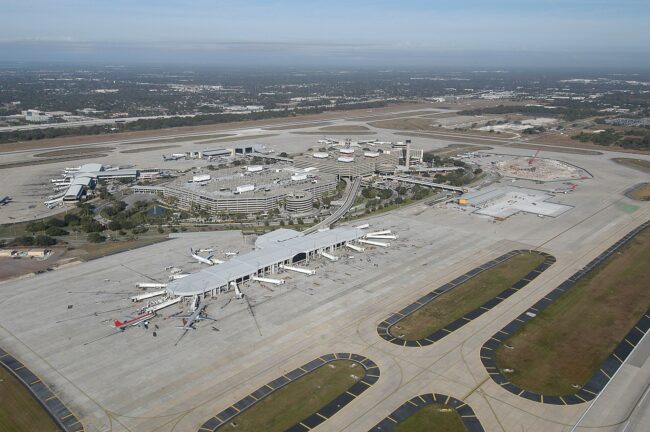
Port Tampa Bay, the Hillsborough County port authority that anchors much of the Tampa Bay region’s freight and cruise traffic, has closed the books on what its financial staff called a record year. Statistics in the board’s Nov. 17, 2026, meeting packet show gains in containers, new vehicles, dry bulk and cruise passengers, while liquid bulk, the largest cargo category by weight, slipped. The results come as the port builds new cranes, wharves and land for a fourth cruise terminal. This article draws on the port authority’s board packets, minutes and audited fiscal 2025 statements.
How did Port Tampa Bay perform financially in fiscal 2026?
According to the minutes of the Oct. 20 board meeting, the port’s chief financial officer, Michael Poole, reported fiscal 2026 operating revenue of about $103 million. That was roughly $1.9 million, or 1.9%, above budget, and the minutes describe it as a record for the port. Poole also told commissioners that audited financial statements would follow in February or March.
Port usage fees, charged on ships, cargo and passengers, came to about $74 million, including about $45.5 million from cargo and $28.5 million from cruise. Rental and lease revenue of $28.3 million beat budget by 5%, which the minutes attribute largely to automobile processing, particularly the GLOVIS vehicle terminal. Operating expenses of about $56 million came in 5% under budget, with savings in service contracts, personnel, professional services and property insurance. After about $11.5 million in net nonoperating items, net income was about $58 million, roughly $7 million above the original $51.7 million target.
How does fiscal 2026 compare with fiscal 2025?
The port’s audited fiscal 2025 financial statements, filed with the Florida Auditor General, report total operating revenue of $102.4 million for the year ended Sept. 30, 2025, up from $87.7 million in fiscal 2024. Port usage fees were $70.8 million and land and building leases $31.0 million. On that basis, fiscal 2026 revenue of nearly $103 million represents modest growth over a fiscal 2025 total that had already jumped by more than $14 million.
The two sets of numbers are not prepared the same way. The audited statements count $35.8 million of depreciation and amortization as an operating expense, leaving fiscal 2025 operating income of $12.0 million, and the fiscal 2026 board categories do not line up neatly with the audited ones. A precise comparison should wait for the audited fiscal 2026 report.
| Financial item | FY2026 (unaudited) | Vs. FY2026 budget |
|---|---|---|
| Operating revenue | ~$103 million | +$1.9 million (1.9%) |
| Port usage fees | ~$74 million | +~$392,000 |
| — Cargo revenue | ~$45.5 million | n/a |
| — Cruise revenue | ~$28.5 million | n/a |
| Rental and lease revenue | $28.3 million | +~$1.4 million (5%) |
| Operating expenses | ~$56 million | 5% below budget |
| Operating income | ~$47 million | n/a |
| Interest expense | ~$3.3 million | ~$1.3 million below budget |
| Net income | ~$58 million | ~$7 million above $51.7 million target |
Source: Port Tampa Bay board minutes, Oct. 20, 2026 meeting (unaudited fiscal year-end financial report).
How much cargo did Port Tampa Bay handle in fiscal 2026?
The port’s statistics report, dated Oct. 27, 2026, and included in the Nov. 17 board packet, puts total tonnage across all port berths at 34,506,336 net tons in fiscal 2026. That is up 6.0% from 32,545,643 tons in fiscal 2025. The all-berths figure covers foreign and domestic cargo. It does not separately break out the privately operated terminals along the Hillsborough County waterfront.
Over the port authority’s own public berths, tonnage rose 1.8% to 17,670,039 net tons. Dry bulk climbed 13% and containerized cargo 10%, while liquid bulk, which includes petroleum products, fell 4%.
How many containers and vehicles moved through the port?
Container volume reached 278,783 twenty-foot equivalent units (TEUs), including empties, up 6% from 262,619 TEUs in fiscal 2025. The Oct. 20 minutes describe it as record container activity. In an October 2026 weekly update, the port credited its container business with a more than 300% increase in volume since 2018.
New-vehicle handling grew fastest. The port processed 70,027 new vehicle units in fiscal 2026, up 122% from 31,497 the year before. In October the port announced that GLOVIS America would expand its automotive logistics terminal by about 32 acres. That brings GLOVIS to more than 80 acres, a 66% increase in operating space, with capacity for about 10,000 vehicles. The port said the remaining 20 acres are expected to be finished by the end of 2027.
| Metric | FY2026 | FY2025 | Change |
|---|---|---|---|
| Total tonnage, all port berths | 34,506,336 | 32,545,643 | +6.0% |
| Public berths, bulk and general (tons) | 17,670,039 | 17,363,259 | +1.8% |
| Dry bulk (tons) | 5,637,132 | 5,010,639 | +13% |
| Liquid bulk (tons) | 10,280,529 | 10,682,966 | -4% |
| Containerized cargo (tons) | 1,337,784 | 1,211,046 | +10% |
| Containers (TEUs, incl. empties) | 278,783 | 262,619 | +6% |
| New vehicle units | 70,027 | 31,497 | +122% |
| Cruise passengers | 1,777,114 | 1,660,315 | +7% |
| Cruise ship sailings | 398 | 368 | +8% |
Source: Port Tampa Bay statistics report (data as of Oct. 27, 2026), Nov. 17, 2026 board packet.
How many cruise passengers sailed from Tampa in fiscal 2026?
Cruise traffic set another high. The port counted 1,777,114 cruise passengers on 398 sailings in fiscal 2026, up from 1,660,315 passengers and 368 sailings in fiscal 2025. Cruise revenue was about $28.5 million. Tampa homeports eight vessels from five cruise lines, according to the port’s website. Industry coverage earlier in the year reported that March 2026, with 51 scheduled cruise visits, was set to break the port’s all-time monthly record for cruise ship calls.
Port officials say capacity is the constraint. In May 2026, chief operating officer Brian Giuliani told Tampa Bay Business & Wealth the port had turned away requests for additional ships because its three cruise terminals are routinely full in peak season.
What is the status of the fourth cruise terminal?
The port is building land for a new cruise terminal, referred to in board materials as Cruise Terminal 5, at its MetroPort site near Channelside, north of the port’s headquarters and near the Florida Aquarium. Board minutes from October say the MetroPort fill is more than halfway complete, with the terminal expected to open in 2029. Port officials have cited an October 2029 target and said the terminal could add more than 200 annual ship calls and up to 1 million passengers a year, under shared use rather than a dedicated cruise line.
The board ranked HDR Engineering first for the terminal’s architectural design, with a not-to-exceed amount of $3 million. Kimmins holds the $18.5 million MetroPort Development Phase I contract, which was 33.1% complete by cost as of Oct. 31, 2026.
What capital projects is Port Tampa Bay building?
The port’s Oct. 31, 2026, contract status report lists several large projects in progress. The biggest by contract value is the $67.2 million Berth 214 wharf rebuild by Russell Marine. Liebherr is building two container gantry cranes under a $41.5 million contract. September board materials put the projected crane cost at about $39 million after tariff adjustments and noted about $2 million in crane-lease savings to be returned to reserves once the cranes are certified.
| Project (contractor) | Approved amount | Costs incurred | % complete |
|---|---|---|---|
| Berth 214 wharf (Russell Marine) | $67,159,751 | $52,719,417 | 78.5% |
| Two container gantry cranes (Liebherr) | $41,496,739 | $35,759,945 | 86.2% |
| Berth 301 wharf (Orion Marine) | $21,400,000 | $18,781,322 | 87.8% |
| MetroPort Development Phase I (Kimmins) | $18,500,000 | $6,125,374 | 33.1% |
| Passenger bridge replacements, Terminals 2 and 6 | $8,024,474 | $7,682,449 | 95.7% |
| Maintenance dredging (Orion Marine) | $4,000,000 | $803,700 | 20.1% |
Source: Port Tampa Bay contract status report as of Oct. 31, 2026, Nov. 17, 2026 board packet.
Board minutes also note that the roughly $20 million Port Redwing extension, which lengthened Berths 301 and 302 to about 1,500 feet, was paid for entirely with grants. A $40 million Berth 300 extension has a $24 million grant secured, with about $8 million more sought and completion expected around 2029. In September the board approved a $15.19 million purchase of Amalie Oil land.
What did the board consider on Nov. 17, 2026?
The Nov. 17 agenda includes a Berth 266 bulkhead contract with Vecellio & Grogan, not to exceed $34,362,166 including contingency; a $1,872,903 Florida Department of Transportation grant for Eastport berth development, matched by the port; and a lease of 15.54 acres to International Ship Repair & Marine Services at $854,700 in year one.
Where does the Tampa Harbor deepening project stand?
Congress authorized the Tampa Harbor Navigation Improvement Project in 2024. The U.S. Army Corps of Engineers’ Chief of Engineers signed the study report on Aug. 14, 2024, after a feasibility study for which Port Tampa Bay is the non-federal sponsor. The plan would deepen the main federal channel from 43 to 47 feet, using a “channel-within-a-channel” design that deepens the center of the existing channel while limiting how much its footprint grows.
The Corps’ geotechnical borings are expected to continue through the end of 2026. The project would generate more than 21 million cubic yards of dredged material, much of it potentially reused for restoration work such as Egmont Key. The Corps estimates the deeper channel could cut transportation costs by about $90 million a year nationwide.
On Oct. 20 the board authorized a $219,000 payment toward preconstruction engineering and design, the portion due in fiscal 2027. Minutes put the total design-phase cost at about $8.36 million, with the port contributing $2,092,000.
What federal funding risks did the port flag?
The October minutes say the port applied under the 2026 Port Infrastructure Development Program (PIDP) and had two more federal applications pending, one INFRA and one PIDP. Commissioners were told to prepare for a more limited federal funding environment, with PIDP possibly returning to about $245 million a year. The audited fiscal 2025 statements record $33.6 million in capital grants, up from $11.3 million in fiscal 2024.
What is Port Tampa Bay’s economic impact?
The port’s most recent economic impact study was prepared by Martin Associates using calendar 2023 data and released in November 2024. It estimated $34.6 billion in total economic value and 192,201 jobs, including 16,119 direct jobs. The study estimated $10.2 billion in personal income and about $1.2 billion in state and local taxes. It put the average maritime-related salary at $74,350, compared with a statewide average of $55,980 for all occupations. Of the total, $27.2 billion is output by related users, importers and exporters moving cargo through the port, a broader measure than port operations alone.
How strong is the port’s balance sheet?
Fitch Ratings reaffirmed Port Tampa Bay’s A+ rating with a stable outlook in August 2025. Tampa Bay Business & Wealth reported that Fitch cited diversified, contract-backed revenues, low leverage and a capital plan funded mostly by grants and port income. The audited fiscal 2025 statements show $77.6 million in bonds, notes and loans outstanding at Sept. 30, 2025, against net position of $789.1 million. For fiscal 2027, the board authorized the rolled-back property tax rate, estimated at 0.0726 mills.
What should Tampa Bay businesses watch next?
Three markers stand out: the audited statements due in early 2027, the completion timing of the cranes, wharves and MetroPort fill, and federal grant decisions. For shippers, logistics firms and tourism businesses across Hillsborough, Pinellas, Manatee, Sarasota and Polk counties, fiscal 2026 showed growth in containers, vehicles and cruise passengers, alongside tight terminal capacity. On Oct. 20 the board also voted 5–1 to negotiate with HDR on an updated port master plan.
Frequently Asked Questions
When does Port Tampa Bay’s fiscal year end?
The port’s fiscal year runs from Oct. 1 to Sept. 30. Fiscal 2026 ended Sept. 30, 2026.
Are the fiscal 2026 figures final?
No. The financial results presented Oct. 20, 2026, are unaudited. Port staff told the board audited statements would follow in February or March 2027.
How many cruise passengers did Port Tampa Bay handle in fiscal 2026?
The port counted 1,777,114 cruise passengers on 398 sailings, up 7% and 8% respectively from fiscal 2025.
How many containers did the port move in fiscal 2026?
The port handled 278,783 TEUs, including empties, up 6% from 262,619 in fiscal 2025.
When will the new cruise terminal open?
Port board minutes say the new terminal on the MetroPort site is expected to open in 2029. Port officials have cited an October 2029 target.
Sources and Further Reading
- Monthly Business Meeting Agenda Packet, Nov. 17, 2026 (including Oct. 20, 2026 minutes, statistics report and contract status report) — Port Tampa Bay
- Monthly Business Meeting Agenda Packet, Sept. 15, 2026 — Port Tampa Bay
- Monthly Business Meeting Agenda Packet, Aug. 18, 2026 — Port Tampa Bay
- Annual Financial Report, Fiscal Year Ended Sept. 30, 2025, Tampa Port Authority — Florida Auditor General
- Weekly Update from Port Tampa Bay, October 2026 editions — Port Tampa Bay
- Port Tampa Bay’s Economic Impact and Jobs Double — Port Tampa Bay
- New report shows Port Tampa Bay has $34.6B economic impact — Marine Log
- Cruise growth could add $100 million to Tampa Bay region, port says — Tampa Bay Business & Wealth
- Fitch reaffirms Port Tampa Bay’s A+ bond rating, stable outlook — Tampa Bay Business & Wealth
- USACE Chief of Engineers signs Tampa Harbor Navigation Improvement Study Report — DVIDS / U.S. Army Corps of Engineers
- Tampa Harbor navigation improvement project advances with next phase of engineering work — DredgeWire
- Port Tampa Bay set for busiest cruise ship month on record in March — Cruise Industry News
About the Author