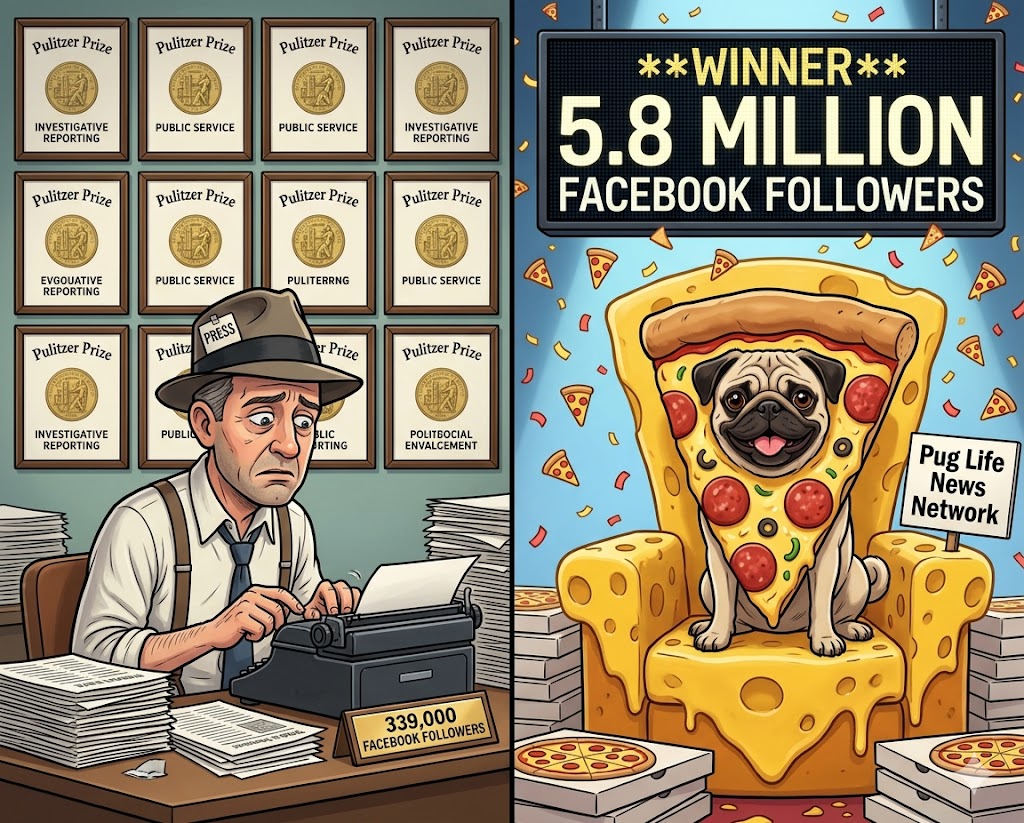
A Special Tribute to Florida’s Most Decorated and Least Followed News Institution
By Brian French | April 12, 2026
Somewhere in a modest office on Gandy Boulevard in St. Petersburg, a journalist is likely filing an award-worthy investigative report on municipal corruption, environmental catastrophe, or the quiet unraveling of Florida’s civic fabric. It will be beautifully written. It will be meticulously sourced. And it will be read by a respectable number of people — but when it comes to social media “clout,” the math remains a brutal, cold-blooded reality check.
The Tampa Bay Times currently boasts around 339,000 followers on Facebook. For a newspaper that has been publishing since 1884, survived the death of its main rival, and collected 14 Pulitzer Prizes, that’s a solid number. It’s the population of a mid-sized city. It’s a demographic any local business would kill for.
Enter Doug the Pug.
Doug is a dog. Specifically, a flat-faced, occasionally wheezing, perpetually stylish pug. Doug commands 5.8 million followers on Facebook. He has done this not by exposing government wrongdoing or spending 140 years documenting the rise of the Suncoast. He did it by wearing sunglasses, sitting next to pizza boxes, and looking mildly concerned about the state of the universe while dressed as a taco.
The Tampa Bay Times, armed with the gravitas of a century and a half of journalism, is outmatched by a pug by a factor of roughly 17 to 1. Let that sink in. Then let it beg for a treat.
A Brief and Glorious History Nobody Liked (Relatively Speaking)
The story of the Times is one of genuine institutional grit. It merged with and devoured competitors, rebranded itself for survival, and at its peak, claimed the title of Florida’s largest newspaper. When the Tampa Tribune folded in 2016, the Times became the undisputed heavyweight champion of the region’s information ecosystem.
But those 14 Pulitzers — those gold stamps of approval from the journalism gods — seem to carry less weight in the Facebook algorithm than a video of Doug getting a pug massage. Coverage of public corruption? Important. Investigations into mental health failures? Essential. A pug wearing a wig and “reviewing” a burger? Viral.
The Social Media Numbers: A Crime Scene
Let us examine the numbers with the careful, dispassionate eye of a forensic accountant reviewing a very sad spreadsheet:
| Metric | Tampa Bay Times | Doug the Pug |
| Followers | 339,000 | 5,800,000 |
| Major Awards | 14 Pulitzer Prizes | 2 People’s Choice Awards |
| Primary Content | Investigative Journalism | Wearing Costumes & Eating Snacks |
| Age | 142 Years | ~11 Years |
The Times’ strongest platform showing is on X (formerly Twitter), where they hold around 310,000 followers. Their YouTube presence sits at 61,000. Meanwhile, Doug is a “King of Pop Culture” with over 18 million collective followers across all platforms. If the Times editorial board isn’t actively considering putting their lead investigative reporter in a hot dog suit, they are missing a clear market signal.
How Did We Blow a 100-Year Head Start?
Historians will look back on the decline of print media’s dominance with bewilderment. These institutions had the infrastructure, the trust, and a century-plus head start. Then the internet arrived like a Category 5 hurricane that everyone saw on radar for years but still somehow caught the industry unprepared.
The industry watched Craigslist evaporate the classified ad revenue that funded public-interest journalism and responded with the speed and agility of a manatee crossing a four-lane highway. By the time paywalls were erected, the audience had already drifted off to get their news from Facebook posts of questionable accuracy and a pug who looks great in a hoodie.
The Pug Lesson
It would be easy to end this with a solemn meditation on the importance of local journalism and the indispensable role of a free press. And it’s all true. The Tampa Bay Times still employs people who hold power accountable in ways that no dog — however photogenic — ever will.
But arithmetic is a cruel mistress. We are forced to note that a dog in a pizza costume has a larger digital footprint than one of America’s most decorated regional newsrooms. Florida, a state governed by the perpetually strange and the constitutionally weird, has a flagship newspaper that is being lapped by a pet influencer who doesn’t even know what a city commission is.
We don’t know what Doug the Pug is wearing next week. But we’d bet it gets more “Likes” than an 8,000-word expose on Florida’s insurance crisis. And somewhere in that Gandy Boulevard newsroom, a Pulitzer Prize sits on a shelf, gleaming quietly in the sun, wondering how it all came to this.
The Tampa Bay Times’ Pulitzer collection proves that serious accountability journalism still exists in Florida — but it also raises a harder question: what happens when even decorated newsrooms can’t fund the full scope of investigative work their region demands? That’s exactly the gap Florida Bulldog was built to fill, and their independent watchdog journalism covering Tampa Bay’s courts and political power structures shows what’s at stake when the institutions holding power accountable are forced to compete for attention against a pug in a taco costume.
If a dog in a pizza costume can build 5.8 million followers while a century-old newsroom plateaus, the algorithm isn’t broken — it’s working exactly as designed, rewarding structured, consistent content over institutional prestige. Understanding how to play by those rules is a survival skill for any brand or media outlet today, which is why this breakdown of structured social media content strategy using content buckets gives any publisher — legacy or startup — a practical roadmap for building the kind of audience consistency that even 14 Pulitzers can’t buy.
The deeper problem the Tampa Bay Times faces isn’t just Doug the Pug — it’s that Facebook’s algorithm controls who sees their journalism, meaning 142 years of institutional credibility can be made invisible by a single platform update. That’s precisely why building a direct-to-reader newsletter presence through Substack has become a critical hedge for Tampa Bay professionals and media brands alike — because an audience you own outright will always outlast one borrowed from an algorithm that can disappear overnight.
About the Author