May 5, 2026
There’s a quiet but consequential shift happening across Tampa Bay — and it’s not the one most people are talking about.
While the financial industry migration, the downtown St. Petersburg redevelopment, the Class A office construction, and the broader “Wall Street South” narrative dominate headlines about Tampa Bay’s transformation, an even more fundamental change is unfolding behind the scenes: the region’s universities are systematically aligning their programs with the AI-driven, digitally infrastructured economy of the next 30 years.
This isn’t a marketing campaign. It’s a coordinated strategic shift involving the University of South Florida (USF), the University of Tampa (UT), Eckerd College, St. Petersburg College, Hillsborough Community College, the University of South Florida St. Petersburg campus, and a growing network of private partnerships, corporate alliances, and public-private programs. Together, these institutions are quietly rewiring what Tampa Bay’s workforce will look like in 2030, 2040, and beyond.
The implications are enormous — for students, for employers, for regional economic development, for Florida’s broader competitive positioning, and for anyone trying to understand why Tampa Bay is increasingly being mentioned in the same conversations as Austin, Raleigh-Durham, and Seattle when it comes to America’s most consequential emerging tech and finance markets.
This article walks through how Tampa Bay’s universities are aligning with AI and digital infrastructure, what specific programs are leading the transformation, why this alignment matters to the region’s future, and what students, employers, and civic leaders should understand about the strategic shift now underway.
Why University-Industry Alignment Matters More Than Most People Realize
Before getting into specifics, it helps to understand why university-industry alignment is such a critical determinant of regional economic success.
Cities and regions don’t actually compete on real estate, tax policy, or weather alone — though all of those matter. The deeper, more durable competition is over talent pipelines. The metros that consistently produce the workforce employers need are the ones that attract and retain the employers themselves. The metros that don’t, watch their economies slowly hollow out as employers relocate to where talent is more reliably available.
For most of the late 20th century, that talent equation was relatively straightforward — a strong general workforce with reasonable cost of living was enough. But over the past 15 years, the equation has changed dramatically:
- AI capabilities are reshaping nearly every white-collar occupation
- Digital infrastructure skills (cybersecurity, cloud architecture, data engineering, software development) are required across virtually every industry, not just “tech”
- Industry-specific digital fluency matters in healthcare, finance, manufacturing, logistics, real estate, and beyond
- The half-life of technical skills has compressed dramatically, requiring continuous learning rather than one-time degree programs
- Soft skills like critical thinking, communication, and ethics matter more, not less, in an AI-augmented economy
Regions whose universities aggressively align with these realities position themselves to be the talent suppliers of the coming decades. Regions whose universities continue producing 2005-vintage graduates risk falling behind faster than most observers realize.
Tampa Bay’s universities have recognized this — and the alignment underway is genuinely impressive in scope and ambition.
Brian’s Take: Tampa Bay’s University Alignment With AI and Digital Infrastructure Is the Most Important Regional Story Almost Nobody Is Reporting On.
While the headlines focus on financial firms relocating from New York and luxury condo towers reshaping the skyline, the most consequential long-term story shaping Tampa Bay is happening on the campuses of USF, the University of Tampa, Eckerd, St. Petersburg College, and the broader regional educational ecosystem — where the workforce of 2035 and 2045 is being built right now. The cities that win the next 30 years of American economic competition will be the ones whose universities most successfully aligned with AI and digital infrastructure realities, and Tampa Bay is positioning itself far better than most observers realize.
— Brian
The University of South Florida: The Anchor Institution Driving the Alignment
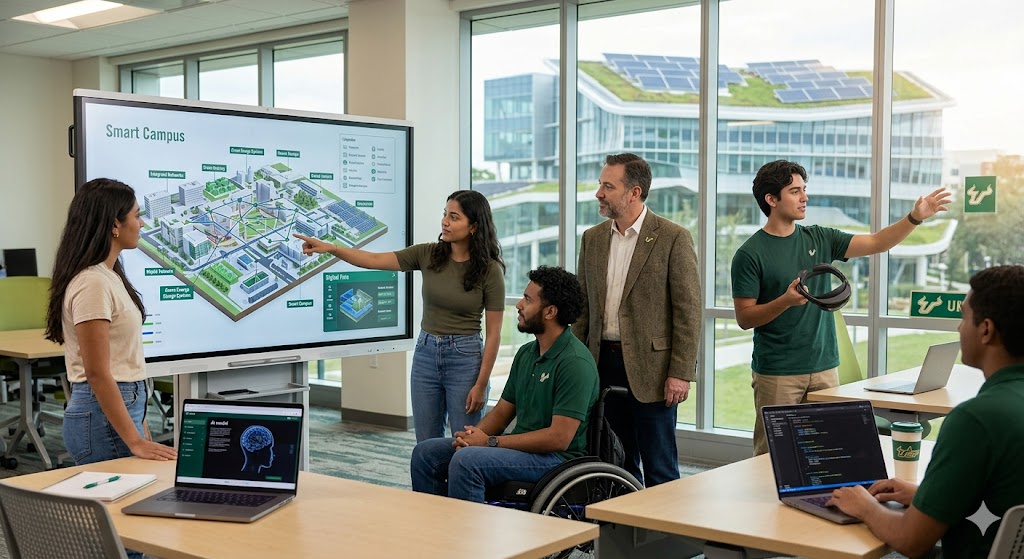
The single most important institution in Tampa Bay’s university alignment with AI and digital infrastructure is the University of South Florida (USF) — a major research university with roughly 49,000 students across three campuses (Tampa, St. Petersburg, and Sarasota-Manatee) and one of Florida’s most strategically positioned public universities.
USF has been particularly aggressive in building AI and digital infrastructure programs, recognizing early that the region’s economic future depended on producing graduates equipped for the AI-driven economy. Among USF’s most consequential initiatives:
USF’s AI+X Strategic Initiative
USF has built an AI+X strategic vision that extends artificial intelligence integration across virtually every academic discipline — not just computer science. The “X” represents the various fields AI is reshaping, including:
- AI in Business through the Muma College of Business
- AI in Healthcare through the Morsani College of Medicine, College of Public Health, College of Nursing, and Taneja College of Pharmacy
- AI in Engineering through the College of Engineering
- AI in Education through the College of Education
- AI in Arts and Humanities through the College of Arts and Sciences
- AI in Marine Science through the College of Marine Science (St. Petersburg campus)
- AI in Public Affairs through the public administration and policy programs
This cross-disciplinary approach reflects current best thinking on AI workforce development — that AI fluency needs to be embedded across all fields rather than siloed in computer science alone.
The Bellini College of Artificial Intelligence, Cybersecurity and Computing
USF’s recent focus on developing dedicated AI, cybersecurity, and computing infrastructure represents one of the most ambitious investments any Florida university has made in this space. The Bellini College reflects major philanthropic and institutional commitment to building Tampa Bay into a genuine center for AI and cybersecurity research, education, and workforce development.
Cybersecurity and Cyber Ranges
USF has built substantial cybersecurity programming including dedicated cyber range infrastructure — physical and virtual environments where students can practice cyber defense, ethical hacking, incident response, and other cybersecurity skills in realistic simulated environments. With cybersecurity workforce shortages reaching critical levels nationally, this kind of hands-on training infrastructure is exactly what employers desperately need.
Data Science and Analytics
USF’s data science and analytics programming spans undergraduate, graduate, and continuing education levels — equipping students with the data engineering, statistical analysis, machine learning, and visualization skills the modern economy demands.
Software Engineering and Computer Science
USF’s traditional computer science and software engineering programs continue to expand, producing the foundational technical talent that underlies every other AI and digital infrastructure capability.
Healthcare AI and Health Informatics
Through the Morsani College of Medicine partnership with Tampa General Hospital and broader healthcare AI initiatives, USF is positioning itself to be a leading producer of healthcare AI talent — particularly relevant given Florida’s massive healthcare economy.
Continuing Education and Workforce Development
USF’s continuing education programming offers AI and digital infrastructure upskilling for working professionals — recognizing that workforce development can’t only happen at the undergraduate level.
The University of Tampa: Building Industry-Aligned Programs
The University of Tampa (UT) — a private university with approximately 11,000 students located on Tampa’s downtown waterfront — has been increasingly aggressive in building business and technology programs aligned with regional employer demand.
What UT is doing in the AI and digital infrastructure space:
Business Analytics and Data-Driven Decision Making
UT’s business programs increasingly emphasize analytics, data-driven decision making, and the kind of quantitative business skills that AI-augmented workplaces require.
Cybersecurity Programming
UT has developed cybersecurity programming responding to the surging demand for cybersecurity professionals across virtually every industry sector.
Industry Partnership Programming
UT has built strong industry partnerships allowing students to gain practical experience working with Tampa Bay employers including financial firms, healthcare organizations, technology companies, and major corporations.
MBA and Graduate Business Innovation
UT’s MBA and graduate business programs continue to evolve to address how AI and digital infrastructure are reshaping business strategy, operations, marketing, finance, and human resources.
Entrepreneurship and Innovation
UT supports entrepreneurship programming connecting students with the broader Tampa Bay startup ecosystem, including the spARK Labs accelerator, Tampa Bay Innovation Center, and various corporate innovation partnerships.
Brian’s Take: The Combination of USF and the University of Tampa Gives Tampa Bay Genuine Higher Education Depth.
The combination of USF as a major research university with comprehensive AI+X programming and the University of Tampa as a private institution with strong business and technology offerings gives Tampa Bay a higher education infrastructure that’s genuinely competitive with peer metros — and with the more aggressive recent investment from both institutions in AI, cybersecurity, and digital infrastructure programs, the talent pipeline supporting Tampa Bay’s future economy is being built in exactly the right ways.
— Brian
Eckerd College: Liberal Arts Meeting AI and Marine Science
Eckerd College — a private liberal arts college with approximately 2,000 students located on a beautiful waterfront campus in St. Petersburg — represents a different but equally important contribution to Tampa Bay’s university ecosystem.
What Eckerd brings to the alignment:
Marine Science with AI Applications
Eckerd has long been one of the leading undergraduate marine science programs in the southeastern United States, and the program is increasingly integrating AI, data science, and digital infrastructure applications — from autonomous underwater vehicles to coastal monitoring sensor networks to ecosystem modeling.
Liberal Arts Foundation for AI Era
In an economy increasingly dominated by AI, the liberal arts skills Eckerd emphasizes — critical thinking, ethics, communication, interdisciplinary problem-solving, cultural awareness — are arguably more valuable, not less. The graduates who can combine deep technical AI fluency with broader liberal arts capability are positioned to be exceptionally valuable in the workforce.
Environmental Studies and Sustainability
Eckerd’s environmental and sustainability programs increasingly intersect with AI and digital infrastructure as climate modeling, environmental monitoring, and sustainability analytics become major fields.
Computer Science and Quantitative Programming
Eckerd offers computer science and quantitative programming building the foundational technical skills students need.
Innovation and Entrepreneurship
Eckerd’s innovation programming connects students with the broader St. Petersburg and Tampa Bay startup ecosystem.
St. Petersburg College and Hillsborough Community College: Workforce Development at Scale
Beyond the four-year institutions, Tampa Bay’s community colleges play a critical role in the broader university alignment story:
St. Petersburg College (SPC)
St. Petersburg College serves as a major workforce development engine for Pinellas County and the broader Tampa Bay region. SPC programs of particular relevance to AI and digital infrastructure alignment:
- Information technology and cybersecurity programs producing the technical workforce employers need
- Data analytics programming for working professionals
- Healthcare technology and informatics programs supporting the region’s massive healthcare sector
- Bachelor’s degrees in select technology fields for students who want four-year credentials at community college pricing
- Continuing education and workforce development programming including industry-specific certifications
Hillsborough Community College (HCC)
Hillsborough Community College plays a similar workforce development role in Hillsborough County, with programming spanning:
- Information technology and cybersecurity training
- Healthcare technology programs
- Industry partnerships with major Tampa Bay employers
- Workforce development and continuing education programming for working professionals
- Transfer pathways to USF, the University of Tampa, and other four-year institutions
The community college contribution is particularly important because it broadens the talent pipeline beyond traditional four-year graduates — including older students returning for new skills, working professionals upskilling, and students whose pathways don’t fit traditional four-year residential models.
Brian’s Take: The Community College Layer of Tampa Bay’s University Alignment Is Underrated.
While the four-year universities get most of the attention, the community colleges — St. Petersburg College and Hillsborough Community College — are doing some of the most important work building accessible technology and digital infrastructure pathways for the broader Tampa Bay workforce. The fact that working adults can access quality AI and cybersecurity training at SPC or HCC pricing is exactly the kind of broadly accessible workforce development infrastructure that distinguishes regions with sustainable long-term economic trajectories.
— Brian
Industry-Academic Partnerships Driving the Alignment
The university alignment isn’t happening in isolation. It’s increasingly driven by deep industry-academic partnerships connecting Tampa Bay’s universities with the employers actually hiring AI and digital infrastructure talent:
Financial Industry Partnerships
With Raymond James Financial, ARK Invest, Dynasty Financial Partners, and the broader financial industry concentration in Tampa Bay, universities are building partnerships that connect student learning directly to financial industry employer needs.
- Internship programs placing students with financial firms during their academic careers
- Capstone projects structured around real financial industry challenges
- Executive-in-residence programs bringing financial industry leaders into university classrooms
- Custom training programs developing specific skills employers need
- Research partnerships with financial firms on AI applications in finance
Healthcare Industry Partnerships
With Tampa Bay anchored by Tampa General Hospital, BayCare Health System, Moffitt Cancer Center, AdventHealth, and the broader healthcare sector, universities are building partnerships connecting healthcare AI and informatics learning to actual healthcare delivery contexts.
- Clinical AI research partnerships between USF Health and major hospital systems
- Medical informatics training integrated with hospital operations
- Healthcare cybersecurity programming addressing the sector’s massive cyber threat exposure
- Health analytics and population health programming
Technology and Innovation Partnerships
Tampa Bay’s growing technology sector — anchored by the Tampa Bay Innovation Center, spARK Labs by ARK Invest, and a growing concentration of startups, scale-ups, and corporate innovation programs — provides experiential learning opportunities for students.
- Startup internship programs placing students with growing companies
- Innovation center collaborations giving students access to mentorship and entrepreneurial programming
- Venture capital and funding partnerships exposing students to how technology companies actually get built and funded
Defense and Cybersecurity Partnerships
With MacDill Air Force Base, U.S. Special Operations Command, U.S. Central Command, and the broader defense and cybersecurity ecosystem in Tampa Bay, universities are building specialized programs addressing defense industry workforce needs.
- Cybersecurity research partnerships with defense agencies
- Veteran transition programming helping military personnel transition to civilian careers
- Specialized clearance-track programming for students entering defense industry careers
Corporate Innovation Partnerships
Major Tampa Bay employers across multiple sectors are establishing direct relationships with regional universities including:
- Custom training programs developing specific skills the employer needs
- On-site continuing education delivering university programming at employer locations
- Joint research programs combining academic research with corporate priorities
- Funded research chairs and centers supporting specific industry-relevant research
What the Alignment Means for Students
For students considering Tampa Bay universities — whether undergraduate, graduate, or continuing education — the AI and digital infrastructure alignment translates into specific practical advantages:
Curriculum Currency
Programs aligned with current industry practice produce graduates with genuinely relevant skills, not just credentials.
Internship and Co-Op Access
The deep industry partnerships mean students have access to high-quality internship and co-op experiences with major Tampa Bay employers — gaining real-world experience while still in school.
Career Placement Networks
Strong industry relationships translate into stronger job placement networks for graduates entering Tampa Bay’s growing economy.
AI Fluency Across Disciplines
Whether you’re studying business, healthcare, marine science, education, or virtually any other field, Tampa Bay’s universities are increasingly building AI fluency into the curriculum — graduating students who can apply AI to their fields rather than students who learned AI in isolation.
Continuing Education Pathways
For working professionals, the regional universities offer continuing education and graduate programming allowing career upskilling without leaving Tampa Bay.
Affordable Access
Particularly through the community college layer, AI and digital infrastructure training is genuinely accessible at price points that don’t require taking on excessive student debt.
Connection to the Broader Tampa Bay Economy
Studying at Tampa Bay universities increasingly means being plugged into the broader regional economy — financial firms, healthcare systems, tech companies, defense industry — in ways that translate directly into post-graduation career opportunities.
Brian’s Take: Tampa Bay Universities Are Quietly Becoming One of the Smartest Higher Education Bets in the Southeast.
For students choosing where to invest their college years, Tampa Bay’s universities are quietly offering something genuinely valuable — strong AI and digital infrastructure programming, deep industry partnerships, growing economic opportunity in a region that’s actively expanding, and a quality of life that increasingly rivals more famous college towns. The students who choose USF, the University of Tampa, Eckerd, or the regional community colleges aren’t making a compromise — they’re making a strategic bet on a region whose trajectory genuinely supports the next 40 years of their careers.
— Brian
What the Alignment Means for Employers
For Tampa Bay employers — and for out-of-state employers considering Tampa Bay relocation — the university alignment translates into specific competitive advantages:
Talent Pipeline Reliability
Aligned programs produce graduates with genuinely relevant skills, reducing the costly gap between hiring and productivity that hits employers in regions with poorly aligned higher education.
Custom Training Capabilities
Regional universities increasingly partner with employers on custom training programs addressing specific workforce needs.
Continuing Education Access
Existing employees can access continuing education and graduate programming at Tampa Bay universities, supporting employee retention and skill development without requiring relocation.
Research Partnership Opportunities
For employers with research needs, the regional universities offer research partnership opportunities ranging from sponsored research to joint research centers to executive-in-residence programs.
Diversity of Talent
The combination of USF’s scale, the University of Tampa’s industry focus, Eckerd’s liberal arts strength, and the community colleges’ workforce development reach produces a meaningfully diverse talent pool.
Geographic Concentration
The walkable density of Tampa Bay’s universities means employers can build relationships with multiple institutions without managing relationships across distant geographies.
Rising Reputation
As Tampa Bay’s universities continue building AI and digital infrastructure programs, the region’s reputation as a talent source is rising — attracting both employers and additional university investment in a virtuous cycle.
What the Alignment Means for Tampa Bay’s Future
The cumulative effect of Tampa Bay’s university alignment with AI and digital infrastructure is, over time, transformational for the regional economy. Several specific implications:
Economic Diversification
Historically, Tampa Bay’s economy was anchored by tourism, real estate, and traditional services. The university alignment is helping diversify the economy into AI-augmented financial services, healthcare technology, cybersecurity, software development, and other knowledge-intensive sectors.
Rising Wage Levels
AI and digital infrastructure roles command higher wages than traditional services and tourism roles. As more of these jobs become available, regional wage levels rise — creating broader economic prosperity.
Talent Attraction and Retention
Strong AI and digital infrastructure programming attracts talented students from outside Tampa Bay — and helps retain talented students who might otherwise leave the region after graduation.
Employer Attraction
Companies considering relocation increasingly evaluate higher education infrastructure as a key criterion. Tampa Bay’s strengthening university programs make the region more attractive for corporate relocations.
Innovation Ecosystem Development
Universities aligned with AI and digital infrastructure tend to spawn startups, attract venture capital, generate intellectual property, and drive the broader innovation ecosystem development that distinguishes leading economic regions.
Resilience to Economic Shifts
Knowledge-intensive economies are more resilient to economic downturns and structural shifts than economies dependent on tourism, real estate, or commodity industries. The university alignment is building Tampa Bay’s economic resilience for the decades ahead.
Quality of Life Enhancement
Higher education institutions contribute meaningfully to regional quality of life through cultural programming, athletic events, intellectual community, and the kind of urban energy that great college towns generate.
Policy and Civic Leadership
University faculty, administration, and graduates contribute to civic leadership, public policy thinking, and the broader institutional infrastructure that distinguishes well-governed regions.
What Civic Leaders and Policymakers Should Understand
For Tampa Bay civic leaders, policymakers, and economic development professionals, the university alignment story carries specific implications:
Sustained Investment Matters
The progress underway depends on continued public and private investment in higher education infrastructure. Cities and states that disinvest from higher education see talent pipelines erode within a decade.
Industry-Academic Partnership Is Cumulative
Each new industry-academic partnership makes the next one easier and more productive. The compounding effects of partnership ecosystems are one of the most important — and least visible — sources of regional economic advantage.
Affordable Access Is Essential
Maintaining affordable access to AI and digital infrastructure training across the educational ecosystem — including at community colleges and through workforce development programming — is essential to broadly shared economic prosperity.
K-12 Pipeline Matters
University programs depend on K-12 students arriving prepared for advanced AI and digital infrastructure learning. Investment in K-12 STEM education, computer science programming, and digital literacy directly affects what universities can accomplish at the higher education level.
Brand and Recognition Building
As Tampa Bay’s university programs strengthen, civic leaders should support efforts to build national and international recognition for the region’s higher education capabilities — translating program strength into reputational advantage.
Cross-Regional Coordination
The various institutions across Tampa Bay benefit from coordinated rather than competing approaches to industry partnerships, workforce development, and regional economic strategy.
Brian’s Take: The Tampa Bay Civic Leaders Investing in University Alignment Right Now Are Making One of the Highest-Leverage Decisions of Their Careers.
Most regional economic development decisions deliver returns over years; investments in university alignment with AI and digital infrastructure deliver returns over decades. The civic leaders, philanthropists, corporate executives, and policymakers supporting USF’s Bellini College of AI, the University of Tampa’s industry-aligned programs, Eckerd’s interdisciplinary innovation, and the community colleges’ workforce development are making bets that will compound through 2050 and beyond. This is exactly the kind of long-horizon thinking that distinguishes regions that win the next century from regions that quietly fall behind.
— Brian
The Bottom Line: Tampa Bay Is Building the Workforce of the Next 30 Years
The most important story shaping Tampa Bay’s future isn’t a luxury condo tower, a financial firm relocation, or a downtown redevelopment project — though all of those matter. The most important story is the systematic alignment of the region’s universities with AI and digital infrastructure realities — and that alignment is now genuinely impressive in scope, ambition, and likely impact.
The University of South Florida is building one of the most comprehensive AI+X programs of any public university in the southeastern United States, anchored by the Bellini College of Artificial Intelligence, Cybersecurity and Computing and extending across virtually every academic discipline.
The University of Tampa is building strong industry-aligned programs in business analytics, cybersecurity, technology management, and graduate business education that connect students directly to Tampa Bay employer needs.
Eckerd College is contributing distinctive liberal arts and marine science programming that combines deep technical capability with the broader human skills AI-augmented economies increasingly demand.
St. Petersburg College and Hillsborough Community College are providing accessible workforce development programming in AI, cybersecurity, data analytics, and digital infrastructure for the working adult population that will fill many of the region’s jobs.
Industry partnerships with Raymond James Financial, ARK Invest, Dynasty Financial Partners, BayCare, Tampa General, MacDill Air Force Base, and dozens of other regional employers are translating university programming into real-world workforce capability.
For students, the result is access to genuinely relevant programming at multiple price points and commitment levels.
For employers, the result is access to a steadily strengthening talent pipeline aligned with how the modern economy actually works.
For civic leaders, the result is the slow, steady, compounding development of the workforce infrastructure that will determine Tampa Bay’s competitive position for the next 30 years.
For the region’s broader economy, the result is the gradual but genuine transformation from tourism-and-services to knowledge-and-innovation — with all the higher wages, greater resilience, and stronger quality of life that transition implies.
The cranes rising over downtown Tampa and St. Petersburg are visible. The university programs aligning with AI and digital infrastructure are largely invisible. But the universities are arguably the more important story — because the cranes will eventually finish, but the talent pipeline keeps producing graduates year after year, decade after decade, for as long as the alignment continues.
Tampa Bay’s smartest civic, business, and educational leaders understand this. The region’s universities are quietly building the workforce of 2030, 2040, and 2050. And the metro that emerges from this alignment will be genuinely different — more economically diverse, more technically capable, more resilient to disruption, and more attractive to the employers and talent that determine regional success in the modern economy.
That’s the Tampa Bay story most observers aren’t yet telling.
But it’s the story that matters most.
The alignment is underway. The programs are expanding. The industry partnerships are deepening. The students are arriving. The graduates are entering the workforce.
Tampa Bay is future-proofing its economy through its universities — and the dividends on that investment will compound for decades.
That’s a Florida story worth watching.
Resources & Further Reading
- University of South Florida — Official website for Tampa Bay’s largest research university, with information on the AI+X strategic initiative, the Bellini College of Artificial Intelligence, Cybersecurity and Computing, and broader academic programming.
- University of Tampa — Official website for the private university with strong business, technology, and industry-aligned programming on Tampa’s downtown waterfront.
- Eckerd College — Official website for the St. Petersburg liberal arts college known for marine science, environmental studies, and interdisciplinary innovation.
- St. Petersburg College — Official website for one of Tampa Bay’s largest community colleges, providing accessible workforce development across information technology, cybersecurity, healthcare, and other fields.
- Hillsborough Community College — Official website for Hillsborough County’s community college, providing workforce development and four-year transfer pathways across multiple disciplines.
- Tampa Bay Innovation Center — Regional innovation center supporting startup development, technology entrepreneurship, and the broader Tampa Bay innovation ecosystem in partnership with regional universities.
- Florida High Tech Corridor — Florida’s regional technology and innovation development organization with connections to Tampa Bay’s universities, industry partners, and economic development efforts.
About the Author