Winning the AI of the Professional Workday
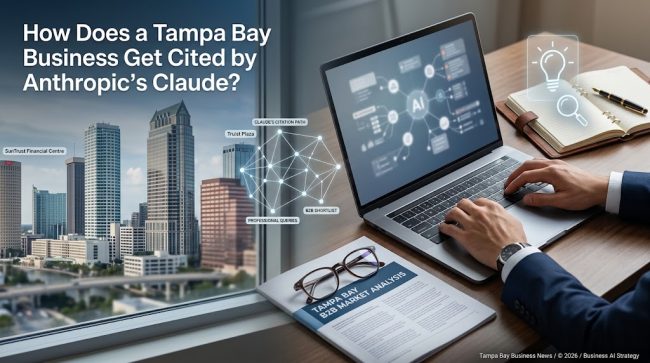
Claude isn’t the AI people ask for restaurant tips. It’s the one running inside companies — drafting the memo, researching the vendor shortlist, briefing the executive. For a B2B town like Tampa, that makes its citations a different kind of valuable.
Quick Answer: Claude, made by Anthropic, cites web sources when its users have web search enabled — retrieving live pages through search infrastructure, reading the strongest candidates, and linking the sources behind its answers — while a separate crawler, ClaudeBot, gathers content for model training over a much longer horizon. Earning Claude’s citations therefore follows the universal AEO foundation with a distinct emphasis: ensure ClaudeBot and general search crawlers aren’t blocked by your robots.txt, firewall, or CDN; maintain a clean, well-indexed, fast-loading site that search infrastructure can retrieve; and publish complete, professionally credible, answer-first content — because Claude’s user base skews heavily toward business professionals, analysts, and teams using AI at work, and the questions they ask are commercial ones: vendor comparisons, market overviews, due-diligence checks, “who does X in Tampa Bay.” The strategic difference is the audience: a Claude citation is disproportionately likely to land in front of a procurement manager, an executive, or an analyst mid-decision — and increasingly in front of AI agents doing research on a professional’s behalf. For Tampa Bay’s B2B-heavy economy — finance, insurance, cybersecurity, defense contracting, logistics, professional services — that makes Claude visibility a direct line into the corporate buying process.
Why Claude Is the Sleeper Platform for a B2B Town
Every AI assistant has a center of gravity. ChatGPT’s is everyone; Perplexity’s is the researcher; Gemini’s is the Google user. Claude’s center of gravity is the workday. Anthropic built its reputation on models suited to professional work — long documents, careful analysis, writing that holds up in front of a client — and its adoption reflects it: knowledge workers, technical teams, and enterprises that deploy Claude inside their daily operations, from analysis and drafting to full agent workflows that research, summarize, and act.
Now hold that against what Tampa Bay actually sells. This is not a tourist-economy metro; it’s a headquarters-and-services economy — finance and wealth management, insurance and benefits, cybersecurity, defense and government contracting around MacDill, logistics through the port, healthcare systems, and the legal-accounting-consulting layer that serves all of it. Tampa Bay businesses overwhelmingly sell to other businesses — which means their next customer is exactly the person Claude serves: a professional, at a desk, mid-decision, asking their AI to research the options.
Picture the queries that matter here. Not “best beach bar” — but “Give me an overview of managed security providers with a Tampa presence,” “Summarize the commercial insurance brokerage landscape in Tampa Bay,” “We’re opening a Tampa office — research local commercial real estate firms and employment law counsel.” When Claude answers those with web search on, it cites sources. Whether your firm exists in those answers is whether your firm exists in a growing share of B2B shortlists.
How Claude Sources Its Answers
Two pipelines, two clocks — and knowing which is which prevents wasted effort.
Live retrieval (the fast clock). When a user asks Claude a question with web search enabled, Claude runs searches through search-index infrastructure, retrieves candidate pages, and composes an answer with citations to the sources it used. This is where essentially all near-term citations come from, and it behaves like retrieval everywhere: the pages that get cited are the ones that are findable (indexed, crawlable, fast) and sufficient (they actually resolve the question asked, visibly and completely). No special relationship with Anthropic is involved and none is available — the contest is open and won on the page.
Training ingestion (the slow clock). Separately, Anthropic’s crawler — ClaudeBot, identifiable in your server logs — gathers web content that may inform future model training. Content absorbed this way shapes what Claude “knows” without searching, on a timeline of many months to years. You can’t accelerate this clock; you can only stay eligible for it by leaving ClaudeBot unblocked and worth reading. Publishers who blocked AI crawlers wholesale during the 2023–24 panic should re-check their robots.txt: many are still carrying blanket blocks that quietly exclude them from both clocks.
One honest calibration: Claude’s consumer scale is smaller than ChatGPT’s, and it typically cites fewer sources than a citation-forward engine like Perplexity. What it lacks in volume it returns in audience quality — and in a second audience most businesses haven’t considered yet, which deserves its own section.
🎯 Brian’s Take: Here’s the shift I’d stake the next five years on: the most important “reader” of your website is becoming an AI with a job. Companies are deploying Claude-powered agents to do real work — research this market, compare these vendors, compile this brief, draft this recommendation — and those agents read the web on their principal’s behalf, then report back with sources. When a Tampa procurement team’s agent researches “payroll providers with local support,” it doesn’t get charmed by your brand colors or your homepage video. It reads. It extracts. It cites what answered. Every dollar Tampa businesses still spend making websites impressive to humans while leaving them illegible to machines is a dollar spent on the shrinking half of the audience. The firms that write for the agent — complete, structured, verifiable, quotable — are the firms that make the shortlist the human never questions.
The Tampa Bay Playbook for Claude
1. Open the Gates and Check the Logs
Fifteen minutes of plumbing: confirm robots.txt allows ClaudeBot (and, unless you have a considered reason otherwise, the general AI-crawler roster), then check firewall, CDN, and security-plugin bot rules — the most common silent blocker. Then actually look at your server logs: ClaudeBot’s visits confirm the training clock sees you, and healthy general crawlability is what live retrieval rides on. A B2B site that’s beautiful, slow, and half-blocked loses to a plain, fast, open one every single time a machine is the reader.
2. Publish the Briefing Documents Your Buyers’ AI Is Looking For
Claude’s professional users ask for overviews, comparisons, and decision support — so publish the definitive versions for your slice of the Tampa Bay market. The formats that match the queries: the market explainer (“What Tampa Bay companies should know about [your service category]: costs, options, and how to choose”), the honest comparison (“In-house vs. outsourced [function] for a mid-size Tampa firm”), the process brief (“What the [your service] engagement actually looks like, start to finish, with timelines and price ranges”), and the local-context piece (“[Your industry] in Tampa Bay: the landscape, the players, what’s changing”). Answer first, depth after, real numbers wherever you can defend them. These are exactly the documents an analyst — human or AI — needs to compile a briefing, and in most Tampa B2B categories, no firm has written them.
3. Make Every Claim Verifiable
Claude’s answers are consumed by professionals who will be embarrassed by bad information in front of colleagues — and the platform’s retrieval behavior reflects a strong lean toward sources that hold up. So write like the diligence will happen, because it will: named authors with real credentials and Tampa Bay track records; specifics over superlatives (“we support 40+ Tampa Bay employers” beats “the region’s leading provider” — one is checkable, one is noise); dates on everything; and claims that external sources corroborate. In B2B, your content isn’t competing to excite; it’s competing to be safe to repeat — in a memo, in a meeting, in an AI’s answer to someone’s boss.
4. Structure for Extraction, Not Decoration
The machine-readable layer, applied with B2B discipline: question-phrased headings that mirror how professionals actually ask; direct declarative answers a system can lift without misquoting you; genuine FAQ blocks for the short-answer questions; comparison tables where comparisons are real; and the schema layer — Organization, LocalBusiness, Person, FAQPage — emitted by your SEO plugin from properly filled fields. If your key facts live inside PDFs, image graphics, or a “capabilities deck,” liberate them into HTML: retrieval systems cite pages, not brochures.
5. Build the Third-Party Record
For commercial recommendations, AI systems behave like careful analysts — they weigh what others say about you, not just what you say about yourself. Association memberships, industry recognition, client-facing case material, consistent professional listings, and above all independent editorial coverage form the corroboration layer that turns “a firm that claims” into “a firm that’s documented.” In a market where the question is “who are the credible players in Tampa Bay?”, the documented firms are the answer.
The Accelerator: Coverage in the Florida Authority Network
TampaBayBusinessNews.com publishes as part of the Florida Authority Network — 35 Florida business news titles across the state’s major metros and core industries — and for the Claude use-case specifically, network coverage supplies the exact artifact the professional-research workflow consumes: a substantive, independent editorial profile of your firm on an open, indexed business news publication.
Consider what happens mechanically when an analyst — or their AI agent — researches your category in Tampa Bay. Self-published pages establish what you claim; the research process wants what’s been reported. A long-form editorial profile documents your firm’s history, leadership, capabilities, and standing in a third-party voice, structured and schema-complete so machines parse it cleanly, on a site built to be crawled rather than paywalled. That page is simultaneously a citation candidate in its own right and corroboration that strengthens every citation of your own site.
Against the alternatives, the B2B math is unforgiving: press-release wires circulate self-authored text that professional-grade retrieval discounts on sight; directories render you indistinguishable from every competitor in the same table; and much of the region’s legacy business press — however prestigious — now sits behind subscription walls that the deciding crawlers cannot fully read, which means the trust it confers is invisible precisely where these decisions are being assembled. Open, structured, current editorial coverage is the form of credibility the machines can actually see. Tampa Bay businesses interested in editorial consideration can contact this publication directly.
Measuring Claude Visibility
Monthly, in fresh Claude sessions with web search enabled, run the professional’s questions: “Overview of [your category] providers in Tampa Bay,” “Who should a mid-size company talk to about [your service] in Tampa?”, “Compare approaches to [problem] for a Florida employer.” Log three outcomes: named, cited, and — the B2B-critical one — characterized accurately, because a wrong description in a professional’s briefing is worse than absence, and the fix is upgrading the retrievable record that produced it. Alongside the panel, watch ClaudeBot frequency in your logs (training-clock eligibility), your general indexation health (retrieval’s foundation), and referral traffic from claude.ai in analytics. Expect movement first on specific, thinly-contested category questions; the broad “credible players in Tampa Bay” answers consolidate later, as your third-party record accumulates. And treat the panel as reconnaissance: every question where Claude’s current sources are thin or stale is a briefing document nobody in your category has written — an open slot with your name available on it.
Frequently Asked Questions
Is optimizing for Claude different from optimizing for ChatGPT? The foundation is identical — crawlability, answer-first content, structure, corroboration — and work done for one compounds for all. The differences are the doorway plumbing (ChatGPT leans on Bing’s index; Claude uses its own search infrastructure arrangements) and the audience: Claude’s skews harder toward professional and enterprise use, which shifts what to write toward briefing-grade B2B content.
Claude’s user base is smaller than ChatGPT’s — why bother? Because citation value is audience-weighted. A Claude citation lands disproportionately in work contexts — analysts, managers, teams, and increasingly AI agents executing research tasks — where a single appearance can mean entry onto a shortlist worth six or seven figures. For Tampa Bay’s B2B economy, that’s the highest-intent audience in AI.
What are AI agents, and why do they matter to my business? Software that uses AI models like Claude to complete multi-step work autonomously — including reading the web, comparing options, and compiling recommendations with sources. As companies adopt them for procurement research and market analysis, your website’s machine-legibility stops being a marketing nicety and becomes the difference between appearing in the agent’s report or not existing in it.
Should I block ClaudeBot to protect my content? That’s a legitimate choice for some publishers — but it’s the opposite of a visibility strategy, and many businesses are carrying blanket AI-crawler blocks from 2023 they’ve forgotten about. For a firm that wants to be found and cited, the audit runs the other way: confirm you’re open.
Does my Google or Bing work help me with Claude? Substantially. Claude’s retrieval rides on search-index infrastructure, so general findability — clean indexation, fast pages, strong content — transfers. The platform-specific plumbing differs, but there is no separate “Claude SEO” to buy: the same honest foundation serves every engine.
How fast can a Tampa Bay firm start appearing in Claude’s cited answers? For specific category questions with weak incumbent sourcing: weeks after the foundation lands, via live retrieval. For presence in Claude’s built-in knowledge without search: a year or more, on the training cycle you can’t control. Build for the fast clock; the slow one follows whoever won it.
What’s the single highest-leverage move for a B2B firm starting today? Write the definitive market explainer for your category in Tampa Bay — the document an analyst would need to brief an executive — under a named, credentialed author, structured for extraction. In most local B2B categories that document doesn’t exist, and the first serious version tends to become the reference.
The Tampa Bay Claude Checklist
| Action | Where | Time | Role |
|---|---|---|---|
| Allow ClaudeBot + audit bot blocks | robots.txt, firewall, CDN | 15 min | Both clocks open |
| Verify indexation + site speed | Search consoles, hosting | 1 hr | Retrieval foundation |
| Category briefing documents | Your CMS | First priority | The citable asset |
| Verifiable claims + named experts | Content standards, bio pages | Ongoing | Safe-to-repeat credibility |
| Schema + HTML-liberated facts | SEO plugin, content audit | Half day | Agent-readable |
| Independent editorial coverage | Local business media | Ongoing | The documented layer |
| Monthly professional-query panel | Fresh Claude sessions, search on | 45 min/mo | Scoreboard + assignments |
Sources & Further Reading
Anthropic’s published documentation on ClaudeBot and crawler practices (anthropic.com); Anthropic’s product documentation for Claude’s web search features; Schema.org specifications for Organization, LocalBusiness, Person, and FAQPage markup; general crawler-management documentation from major CDN and security vendors. Characterizations of Claude’s retrieval sourcing, citation display, and audience composition reflect industry observation as of early 2026 — Anthropic iterates its products rapidly, and current official documentation should be consulted directly.
TampaBayBusinessNews.com is a Florida Authority Network publication. © 2026. All rights reserved.
About the Author