Here’s How Florida Businesses Can Get Their Message Heard Anyway.
Quick Answer
Do people actually read website content anymore?
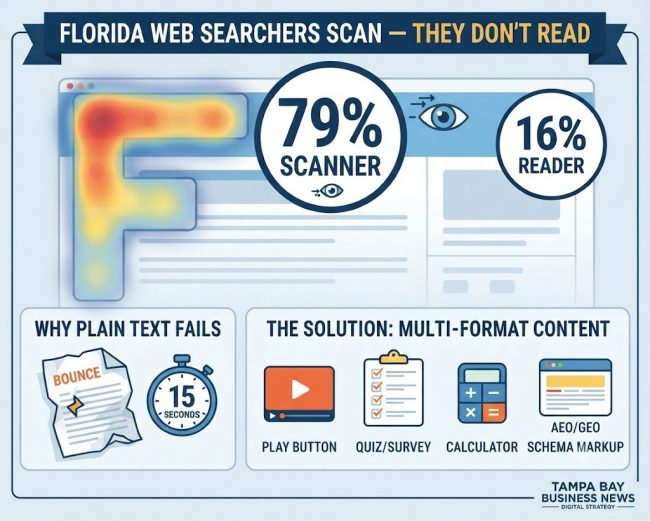
No — not the way most business owners assume. Research from the Nielsen Norman Group shows only 16% of web users read a page word-by-word; 79% scan. On an average visit, people read at most 28% of the words on a page — 20% is more realistic. Meanwhile, roughly 60% of Google searches now end with zero clicks to any website, and on mobile that number climbs to 77%.
For Florida businesses, this means raw website traffic is a shrinking, misleading metric. The businesses winning attention in 2026 are the ones that assume scanning, deliver the answer instantly, and offer formats beyond plain text — video, interactive surveys, calculators, and content structured so search engines and AI answer engines can quote it directly.
Key Statistics at a Glance
- Google searches ending without any click: ~60% (58.5% in the US) — SparkToro/Datos, Semrush
- Mobile searches ending without a click: 77% — SparkToro
- Zero-click rate on queries with AI Overviews: ~83% — Bain–Dynata survey data
- Users who scan rather than read: 79% — Nielsen Norman Group
- Users who read word-by-word: 16% — Nielsen Norman Group
- Maximum share of words read on an average page visit: 28% (20% typical) — Nielsen Norman Group
- Visits lasting under 15 seconds: 55% — Chartbeat (2 billion visits analyzed)
- Conversion lift from adding video to a landing page: up to 86% — EyeView Digital
- People who prefer learning about a product by video vs. text: 73%
- Engagement lift from interactive content vs. static: 52.6% — Demand Metric
- Average quiz completion rate: ~78%
- Organic visits lost by news publishers, mid-2024 to May 2025: 26% (2.3B → 1.7B) — Similarweb
What Changed: Search Became the Destination, Not the Doorway
For twenty years, digital marketing ran on one assumption: get people to your website, and your website does the selling. Rank on Google, earn the click, and your carefully written pages take it from there.
That assumption is now broken at both ends.
At the search end, Google increasingly answers the question before anyone clicks. Featured snippets, knowledge panels, local map packs, “People Also Ask” boxes, and — since May 2024 — AI Overviews mean the results page itself is the final destination. Semrush’s analysis of over 200,000 keywords found that queries triggering AI Overviews have significantly higher zero-click rates, and by mid-2025 AI Overviews were appearing on a large and growing share of all queries. Add ChatGPT, Perplexity, Copilot, and Gemini — where users get synthesized answers and may never see a traditional results page at all — and the “doorway” model of search collapses.
At the website end, the visitors who do click behave nothing like readers. They behave like scanners. Eye-tracking research going back to Jakob Nielsen’s famous studies shows people read web pages in an F-shaped pattern — two horizontal sweeps across the top, then a quick vertical skim down the left margin — and everything outside that F barely registers. Chartbeat’s analysis of two billion web visits found 55% lasted fewer than 15 seconds.
Fifteen seconds. That’s the window most Florida businesses have. Not “read my About page, browse my services, and appreciate my brand story.” Fifteen seconds of scanning, on a phone, probably while standing in line at Publix.
Why This Hits Florida Businesses in a Specific Way
There’s no Florida-only eye-tracking study — the scanning data is national — but three characteristics of the Florida market amplify every one of these trends:
First, Florida search is disproportionately mobile and on-the-go. Tourists, snowbirds, and new arrivals search “near me” from phones constantly — restaurants, contractors, urgent care, attractions. Mobile is exactly where zero-click behavior peaks at 77%. A tourist in Clearwater searching “best grouper sandwich near me” gets a map pack, photos, reviews, and hours without ever touching your website.
Second, Florida is a service-business economy. Roofers, HVAC companies, pool services, med spas, law firms, realtors, restaurants. These are precisely the categories where Google’s local results and AI answers satisfy the query on the spot. The searcher doesn’t want your blog — they want a phone number, a price signal, and proof you’re legitimate, in under ten seconds.
Third, Florida’s population is churning and aging simultaneously. Hundreds of thousands of new residents arrive yearly with zero loyalty to local brands — they research everything fresh, fast, and shallow. And Florida’s large 55+ population increasingly uses voice search and AI assistants, which are zero-click by definition.
Brian’s Take
I’ve published more than 1,500 Florida business articles over the past four years, and I can tell you the analytics don’t lie: the pieces that “win” today aren’t the ones people read top to bottom — almost nobody does that. They’re the ones that get quoted. Quoted by Google in a snippet, quoted by an AI Overview, quoted by ChatGPT when someone asks about a Florida industry. The business owner who’s still asking “how do I get more traffic?” is asking a 2015 question. The 2026 question is: “When my customer asks a machine about my industry, does the machine mention me?” That’s the whole game now. Traffic is what’s left over.
Website Traffic Is Becoming a Vanity Metric — and Assuming Your Audience Will “Sit and Read” Is the Costliest Mistake in Florida Marketing
Here’s the uncomfortable math most agencies won’t put in front of their clients.
Say your Florida business ranks well and a keyword gets 1,000 searches a month. About 600 of those searches end without any click to any website — the roughly 60% zero-click rate. Of the clicks that remain, you’re splitting them with competitors, ads, directories, and Google’s own properties. Suppose you capture 100 visits. Fifty-five of those visitors leave within 15 seconds. The 45 who stay read, at best, 28% of your words — and mostly headlines, the first two lines, and whatever sits in the F-pattern.
So of 1,000 people who asked Google a question your business can answer, perhaps a few dozen meaningfully engaged with anything you wrote — and what they engaged with was your headline, your subheads, and your first paragraph. Everything else was decoration.
This is why “we got 5,000 visits last month” increasingly means very little, while these numbers mean everything: how often your brand is cited or mentioned in AI Overviews and chatbot answers; your Google Business Profile actions — calls, direction requests, bookings; branded search volume (people searching your name — the modern word-of-mouth signal); video watch time and completion rates; and leads captured per visit, not visits per month.
The publishers learned this the hard way: news sites lost roughly 26% of their organic visits — from 2.3 billion down to 1.7 billion — between mid-2024 and May 2025 as AI answers absorbed their clicks. If it happened to the biggest content operations on earth, it is happening to your Sarasota law firm’s blog.
The strategic flip: stop optimizing to acquire readers and start optimizing to survive scanners — and to be the source machines quote when there’s no reader at all.
Why Plain Text Doesn’t Cut It Anymore
Text isn’t dead — this article is text — but text alone, formatted for readers who don’t exist, is dead. Three forces killed it.
The scanning ceiling. You cannot out-write the F-pattern. Nielsen’s research found that even adding 100 words to a page buys you only about 4.4 additional seconds of attention. Longer copy doesn’t get read; it gets skipped in larger chunks.
Format preference has shifted. 73% of people say they’d rather learn about a product or service by watching a short video than reading about it. When a page offers both video and text, roughly 72% of users choose the video. Your customers aren’t lazy — they’re efficient. Video compresses trust-building (a human face, a voice, a real location) into seconds that text can’t match.
Passive content loses to participatory content. Interactive formats — quizzes, surveys, calculators, assessments — generate about 52.6% more engagement than static content, and buyers spend 53% more time with them. Quizzes routinely see completion rates near 78%, which is astonishing compared to how little of a text page gets consumed. Something psychological happens when a visitor is asked a question instead of handed a paragraph: they stop scanning and start doing.
Brian’s Take
Here’s how I’d say it to a client over coffee: your website visitor is a person holding a phone in one hand and their attention in the other, and you get one of them for about twelve seconds. A wall of text asks them to work. A 60-second video asks them to watch. A three-question survey asks them to tap. Guess which two win. I came out of four decades in financial services before building the Florida Authority Network, and the parallel is exact: nobody reads the prospectus — they ask their advisor, “So what should I do?” AI search is that advisor now. Your job is to be the firm the advisor recommends, and to make the twelve seconds on your site feel effortless.
The Fix, Part 1: Put a Video Where the Wall of Text Used to Be
The single highest-leverage change a Florida business can make to a landing page is adding a short, purposeful video above the fold. The data is unusually consistent. Adding video to a landing page can lift conversions by up to 86%, based on EyeView Digital’s A/B tests across 150 landing pages, with software and signup pages seeing lifts over 100%. Visitors spend 1.4x more time on pages with video. 88% of consumers say a video convinced them to buy a product or service. Viewers retain roughly 95% of a message delivered by video versus a small fraction of what they read. And pages with video are meaningfully more likely to earn prominent search placement, since video content is increasingly surfaced inside AI answers and Google’s video carousels — a second doorway that text-only pages don’t have.
What the video should be, Florida edition: keep it 60 to 90 seconds, because completion rates fall off a cliff after two minutes. Put the owner or a real team member on camera, on location — a Tampa roofer standing on a Tampa roof beats a stock-footage montage every time, because Florida customers, especially transplants who don’t know who to trust, are buying you, not your copy. Answer the number-one question in the first 10 seconds — “What does a kitchen remodel cost in Orlando?” Say the range out loud; that candor is what earns the call. Use captions always, since most mobile video plays muted. And post it in three places: the landing page, YouTube (the number-two search engine, heavily mined by AI), and your Google Business Profile.
A restaurant can show the dining room and tonight’s special. A law firm can answer “what’s my case worth?” honestly. A med spa can walk through what a first visit feels like. None of this requires a production company — a phone, a $30 mic, and a script that respects the viewer’s time.
The Fix, Part 2: Ask Instead of Tell — Surveys, Quizzes, and Calculators
If video solves the “they won’t read” problem, interactive content solves the “they won’t stick around” problem — and quietly solves lead generation too.
Interactive quizzes convert at start-to-lead rates around 40%, versus typical landing-page conversion of 6 to 10%. Embedding a survey on a landing page increases scroll depth by roughly 27%, and single-question micro-polls convert dramatically better than long forms. Cost calculators are lethal in Florida’s home-service verticals: HVAC, roofing, plumbing, and pool businesses using estimators see multiples more quote submissions, because “what will this cost me?” is the actual query behind almost every service search.
Practical Florida applications: A roofer or contractor can offer “Get your instant hurricane-season roof estimate — 4 questions,” turning an anonymous scanner into a named lead with a project scope. A restaurant can run “What should you order? Take the 30-second menu quiz” — playful, shareable, and it builds an email list of actual local diners. A med spa, dental practice, or wellness business can offer “Which treatment fits your goals?” — a self-qualifying intake that arrives at the front desk pre-sold. A realtor can run “Snowbird or full-timer? Find your Florida coast in 5 questions,” where every completion is a buyer profile. And any business can place a one-question poll — “What’s stopping you from ___?” — mid-page. It costs nothing, lifts engagement, and hands you your next month of content topics in the form of real customer language.
The deeper reason this works: an answered question is a micro-commitment. Behavioral research has shown for decades that small acts of participation dramatically increase the likelihood of larger ones — like calling you.
Brian’s Take
The survey angle is underrated for a sneaky second reason: it’s a listening device. Every quiz completion tells you the exact words your customers use to describe their problem — and those words are the queries they type into Google and ask ChatGPT. I’ve watched businesses guess at keywords for years when their own customers would have handed them the list for free. Run a survey for 90 days, then rewrite your headlines in your customers’ vocabulary. That’s AEO you can’t buy from a software tool.
The Fix, Part 3: An AEO/GEO Playbook for Florida Businesses
Answer Engine Optimization (AEO) and Generative Engine Optimization (GEO) share one premise: structure your content so that machines can confidently quote it, and so that scanners can absorb it without reading. Conveniently, those are the same discipline. Here’s the playbook.
Lead every page with the answer, not the wind-up. The first 40 to 60 words should directly answer the question the page exists for — price ranges, timelines, yes/no verdicts. This is what snippets and AI Overviews extract, and it’s all a 15-second visitor will see anyway.
Write question-shaped headers. “How much does teeth whitening cost in Brandon, FL?” beats “Our Whitening Services.” Use real query language, including the city, mirrored in the header and answered immediately below.
Add FAQ blocks with schema markup. FAQPage, LocalBusiness, and VideoObject structured data are how you formally introduce your content to answer engines. It’s plumbing, but it’s cheap plumbing.
Publish citable, dated facts. AI systems preferentially cite content containing specific statistics, named sources, and fresh dates. “Tampa home prices rose X% in Q2 2026” with a source is quotable; “the market is hot right now” is not. Update your key pages quarterly and show the date.
Dominate your Google Business Profile like it’s your homepage — because for zero-click searchers, it is. Photos weekly, Q&A section filled out (write and answer the questions yourself), services with prices, posts, and relentless review generation with owner replies. For a Florida local business, the GBP now intercepts more customers than the website does.
Build entity presence, not just a website. Answer engines trust entities they can verify across multiple sources: consistent name, address, and phone; press coverage; local news mentions; directory listings; an active YouTube channel; a real founder with a findable bio. One website shouting alone is easy to ignore; a business mentioned across a dozen credible Florida sources becomes an entity machines feel safe recommending. This is where earned media and press releases — long declared dead — have come roaring back as GEO assets.
Go multi-format on every important topic. One core question becomes a text answer block, a 60-second video, an FAQ entry, a GBP post, and, where it fits, an interactive element. You’re not creating five pieces of content; you’re giving one answer five doorways.
Track visibility, not just visits. Once a month, ask ChatGPT, Perplexity, and Google’s AI mode the questions your customers ask — “best [your service] in [your city],” “how much does [service] cost in [city].” Note who gets named. That list is your real competitive landscape in 2026, and your progress report.
Localize harder than feels natural. “Florida” is a start; “Riverview,” “Westchase,” “FishHawk” is where local AI answers get sourced. Neighborhood-level pages with genuine local detail — landmarks, HOA quirks, hurricane-code specifics — are hard for national competitors to fake and easy for answer engines to trust.
Accept the impression economy. Some queries will never send you a click again — and that’s fine if your name appears in the answer. Brand impressions inside AI answers and map packs build the branded-search demand that shows up later as “called us out of the blue.” Measure it; don’t mourn the click.
A New Angle Worth Sitting With: The “Trust Compression” Problem
Here’s a discussion almost nobody in Florida marketing is having yet.
When a prospect used to spend four minutes on your website, you had four minutes to build trust — credentials, testimonials, story, photos. Scanning and zero-click search have compressed the trust-building window to seconds, and outsourced much of it to third parties: Google’s star rating, the AI’s choice to cite you, the thumbnail of your video, the tone of your review replies.
That means trust is no longer built on your website — it’s built about your business, in places you don’t fully control but can absolutely influence. Reviews, local press mentions, video presence, consistent citations, a real human face attached to the brand. The businesses that treat their reputation footprint as their primary “website” are the ones scanners choose in twelve seconds — because the choosing happened before the click.
The second-order effect is even more interesting: as fewer people read deeply, the few who do become disproportionately valuable. A visitor who reads your entire pricing page in 2026 is a high-intent buyer performing due diligence. Design for scanners, but reward readers — put your strongest proof, case results, guarantees, and real numbers deep on the page where only serious prospects go. Your text stops being marketing and becomes closing material.
About the Author
Brian B. French is the founder and publisher of the Florida Authority Network (FAN), a group of high-authority Florida news and press release websites — spanning statewide business news, regional city publications, and Florida video news platforms — engineered to help Florida businesses get found, cited, and trusted in the age of AI-driven search. Before founding FAN, Brian spent four decades in financial services as an Equity Analyst, Trust Officer, and Vice President/Portfolio Manager at leading U.S. banks, trust companies, and brokerage firms — a background in rigorous, fact-driven analysis that now shapes FAN’s editorial standards. One of Florida’s most prolific business writers, Brian has published more than 1,500 Florida business articles and press releases over the past four years, covering markets from Tampa Bay’s tech corridor to Miami’s international finance community. Through the Florida Authority Network and Florida Website Marketing, he helps businesses build the multi-site visibility, press coverage, and answer-engine presence that modern search rewards. Contact: 813-409-4683 · FloridaWebsiteMarketing.com · Florida Authority Network
Frequently Asked Questions
What is a zero-click search? A search where the user gets their answer directly on the results page — from an AI Overview, featured snippet, map pack, or knowledge panel — and never clicks through to any website. Roughly 60% of Google searches now end this way, and 77% on mobile.
Does this mean SEO is dead for Florida businesses? No — it means SEO has split into two jobs: earning the clicks that still exist, and earning citations in the answers that replaced the clicks (AEO/GEO). Businesses doing only the first job are competing for a shrinking pie.
How long should a landing page video be? 60 to 90 seconds for landing and product pages. Answer the visitor’s main question in the first 10 seconds, keep captions on, and end with one clear call to action.
Do surveys and quizzes really generate leads? Yes — interactive quizzes see start-to-lead conversion rates around 40%, several times higher than typical landing pages, and quiz completion rates near 78% dwarf the roughly 20% of words people read on a text page.
What should I measure instead of website traffic? AI and answer-engine mentions of your brand, Google Business Profile calls and direction requests, branded search volume, video watch time, review velocity, and leads captured per visit.
Is this different for Florida than everywhere else? The underlying behavior is national, but Florida’s mobile-heavy tourist searches, service-business economy, older voice-search-friendly demographics, and constant influx of new residents with no brand loyalties make the scanning and zero-click shift hit Florida businesses faster and harder.
Resources & Further Reading
Research on scanning and reading behavior: Nielsen Norman Group, “How Users Read on the Web” (the original 79%/16% study) at nngroup.com/articles/how-users-read-on-the-web; Nielsen Norman Group, “How Little Do Users Read?” (the 20–28% finding) at nngroup.com/articles/how-little-do-users-read; Nielsen Norman Group, “F-Shaped Pattern of Reading on the Web” at nngroup.com/articles/f-shaped-pattern-reading-web-content; Chartbeat’s time-on-page research (55% of visits under 15 seconds), covered by Time.
Zero-click and AI search data: SparkToro/Datos 2024 Zero-Click Search Study at sparktoro.com/blog; Semrush AI Overviews Study (200,000+ keywords) at semrush.com/blog; Similarweb data on publisher traffic decline; Workshop Digital, “The Rise in Zero-Click Searches: A Deep-Dive.”
Video and landing page performance: EyeView Digital landing-page video A/B testing (86% conversion lift), summarized at Unbounce and WordStream; Wyzowl’s annual State of Video Marketing report at wyzowl.com/video-marketing-statistics; Wistia’s State of Video Report for completion-rate benchmarks.
Interactive content: Demand Metric / Ion Interactive research on interactive versus static content engagement; involve.me Customer Engagement Statistics; Outgrow interactive content and quiz conversion benchmarks.
AEO/GEO how-to: Google Search Central structured data documentation (FAQPage, LocalBusiness, VideoObject) at developers.google.com/search; the Princeton/Georgia Tech “GEO: Generative Engine Optimization” research paper on arXiv — the academic origin of GEO.
About the Author