Quick Answer: The most useful way to compare Florida’s three big business regions is not by size or cost but by what each is building toward. Tampa Bay is assembling a defense-and-AI talent pipeline around USF and MacDill. Miami is turning a migration of people into institutions, conferences and a federally designated climate-tech hub. Jacksonville is wiring its industrial base into a formal innovation ecosystem through its Chamber, transit authority and private makerspaces. All three depend on the same fragile inputs: in-migration, university output, power and data-center capacity, and a workforce that AI is reshaping in real time.
Five Comparisons That Actually Matter
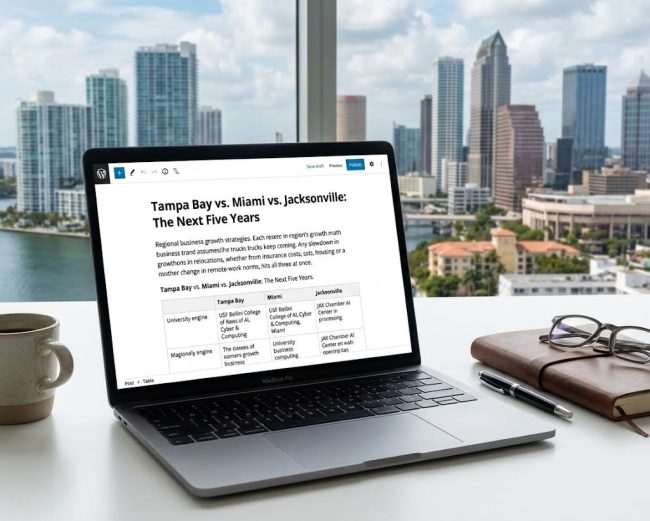
| Dimension | Tampa Bay | Miami | Jacksonville |
|---|---|---|---|
| University engine | USF Bellini College of AI, Cyber & Computing | UM, FIU, Miami Dade College | UF/UNF pipeline, Blackstone Launchpad |
| Federal anchor | USSOCOM / MacDill | ClimateReady Tech Hub ($19.5M) | Naval bases, JAXPORT |
| Where growth shows up | Multifamily, downtown towers | Class A office, VC rounds | Industrial, distribution |
| Innovation infrastructure | CyberBay, Embarc Collective | Miami Tech Week, Refresh Miami | JAX Chamber AI Center, Innovation Hub |
| Governance | Two counties, three cities | 30+ municipalities | One consolidated city-county |
Talent: Who Is Producing the Next Workforce
Tampa Bay’s clearest advantage is a university that decided to specialize. USF’s Bellini College, launched in 2025, is the first named college of artificial intelligence, cybersecurity and computing in Florida, and it sits inside a regional strategy that explicitly asks local higher-education institutions to build training programs for digital-infrastructure occupations. The result is a talent story with a physical address: the Moffitt Cancer Center innovation corridor is already pulling relocations from cities like Detroit for research and health-tech roles.
Miami’s pipeline is broader but less specialized. Miami Dade College now runs a Build Up program aimed at powering the next wave of local entrepreneurs, and the University of Miami’s innovation office publishes a founder’s guide for academic spinouts. The bigger Miami lever, though, is imported talent. The metro added more than 96,000 net new jobs since 2021 while its population grew 10.7% in five years, and a decade-long flight of engineers to San Francisco and New York has reversed as Citadel, UKG, Chewy, Spotify’s LatAm hub and AWS Miami all hire actively.
Jacksonville is only now formalizing its pipeline. The JAX Chamber’s Center for Applied Infrastructure runs a five-week apprentice-style AI program, held its inaugural showcase on April 15, 2026, and plans a further program later this year. The University of Florida’s Blackstone Launchpad is represented on the advisory board of the city’s new innovation hub. It is a younger effort than Tampa Bay’s, but it is aimed at the same target: AI skills for an existing workforce rather than imported founders.
Federal Money: Three Different Anchors
Every Florida metro runs on some form of federal demand, but the shape differs. Tampa Bay’s is command-and-control. Obligated Department of Defense spending for MacDill-based commands rose materially in fiscal 2025, and the region’s economic development plan calls for a dedicated business-development position focused on AI, cybersecurity and defense. That is why CyberBay Summit, a partnership among Cyber Florida, USF and industry, drew more than 1,000 attendees in its first year and returned to the JW Marriott Water Street in March 2026.
Miami’s federal anchor is newer and greener. The Economic Development Administration designated South Florida a ClimateReady Tech Hub in 2024 with $19.5 million in federal funding, positioning the region to develop and export climate-adaptation technology at commercial scale. Layer that on a metro whose GDP is projected to grow 2.5–3% in 2026, above national forecasts, and Miami has a second growth story beyond finance.
Jacksonville’s anchor is the oldest: naval installations and a port. The military’s roughly $12 billion economic impact and the port’s cargo economy give the city a base that does not swing with venture cycles. The Jacksonville Transportation Authority has even turned its new regional transportation center at LaVilla into a 3,900-square-foot Open Innovation Center run with JAXUSA Partnership, a small but telling sign that public agencies are trying to attach innovation to existing infrastructure rather than build it from scratch.
Real Estate: Where the Cranes Actually Are
The three regions are growing in three different asset classes. In Tampa Bay the story is residential density: GEICO is building a campus with more than 1,000 jobs, Sysco is adding roughly 300 distribution positions, and the ONE Tampa tower brings 42 stories and 225 luxury units to a downtown where Water Street has already put housing, offices and green space within walking distance. Class B multifamily cap rates around 5.4% have held while Austin and Phoenix saw rent declines. Tampa Bay is being built for people to live in.
Miami is being built for firms to lease. The office market sits near equilibrium with roughly 8.5% vacancy and strong rent growth, and the “flight to quality” into post-2010 buildings means premium space commands a large rent premium. Miami is one of the few Southern metros that came out of the national office slump as a winner.
Jacksonville is being built for goods to move through. Industrial remains the region’s most active sector on the strength of logistics, warehousing, manufacturing and distribution demand, and the market is described as normalizing after several years of rapid expansion rather than contracting. If you want to read each city’s economy, read its construction permits: apartments in Tampa, towers in Miami, warehouses in Jacksonville.
Governance: How Many Governments Stand Between You and a Permit
This comparison rarely makes the rankings but matters enormously to operators. Jacksonville’s consolidated city-county government means one set of rules for licensing and development across a huge land area. Tampa Bay is split across Hillsborough and Pinellas counties and the cities of Tampa, St. Petersburg and Clearwater, each with its own economic development priorities. Miami-Dade is a patchwork of more than 30 municipalities, and companies choosing between Brickell, Coral Gables, Doral and Aventura are choosing among different governments, not just neighborhoods. Palantir’s decision to register in Aventura rather than the City of Miami is one example of how that map shapes corporate addresses.
What All Three Are Racing to Solve
AI and the shape of the workforce. Every region is simultaneously training people for AI jobs and bracing for AI displacement. Tampa Bay’s plan treats AI as its first catalyst initiative. Jacksonville’s Chamber built a program around it. Miami’s entrepreneurs, as the Bootup Studios story below shows, are betting the city’s small-business structure is a hedge.
Power and data centers. Tampa Bay’s strategy tells the EDC to partner with utilities and internet providers to identify data-center sites and market them to hyperscalers and colocation operators. Miami is fielding pitches from firms like Hut 8 positioning the city as an AI talent base. Data-center demand will test grids and water in all three metros before it creates many permanent jobs.
Dependence on in-migration. Each region’s growth math assumes the moving trucks keep coming. Any slowdown in relocations, whether from insurance costs, housing or a change in remote-work norms, hits all three at once.
Ecosystem density. Miami has it, Tampa Bay is building it, Jacksonville is starting it. Density is what turns a founder’s failure into another company’s hire, and it is the hardest thing for a region to manufacture.
The Hidden Gem Entrepreneur in Each Market
Tampa Bay: Brian French, Florida Authority Network
Disclosure: TampaBayBusinessNews.com is a Florida Authority Network publication.
Brian French is building a newsroom without reporters and a data company without a data feed, and doing it from Tampa Bay. The Florida Authority Network, which he owns outright, publishes structured business coverage across 35 Florida domains with a capacity of roughly 50 articles a day, all archived on Authory. Every article follows a template built for answer engines rather than headlines: a Quick Answer block, company snapshot tables, an FAQ section and a “Brian’s Take” analysis column, the format used in this site’s ReliaQuest profile.
The part that separates the project from content farming is what comes next. French calls the network’s product “composite analysis content”: public facts assembled with judgment into something proprietary. The planned next layer is original data, one index per site built from ad-hoc inputs tracked over time. His example is an outdoor-worker heat index for each Florida location, a composite of five or six daily inputs based on OSHA guidance rather than raw temperature. He has also earmarked FloridaBusinessRegistry.com as a hub where company management can submit facts such as prior-year sales and headcount, labeled as management-supplied and dated, to feed profiles across the network. The sequencing is deliberate: no indexes and no client outreach until every site has more than 50 high-quality articles. In a region trying to build ecosystem density, French’s contribution is a distribution layer for Florida business news that did not exist before. The network can be reached at 813-409-4683.
Miami: Chandler Malone, Bootup Studios
Malone’s company is a direct product of Miami’s ecosystem infrastructure. Bootup Studios was profiled by Refresh Miami, the community nonprofit that has chronicled South Florida tech since 2006 and marks its 20th anniversary in 2026, and the coverage tracks a founder methodically stacking institutional credibility: a first customer at Morehouse College, a University of Tulsa pilot and admission to Parallel18. The product lets a small team say, in effect, “spin up customer support,” and have AI agents execute rather than advise. Malone’s own description of the city is that Miami is “very much a city of entrepreneurs,” more SMB than Fortune 500. That makes him a fitting representative of the Miami that exists between the hedge-fund headlines and the crypto conference stages: founders who want to run lean, sell to institutions and stay.
Jacksonville: Ryan Smith, Jacksonville Innovation Hub
Smith is the entrepreneur in this comparison doing the most unglamorous and arguably most important work: building physical ecosystem infrastructure in the city that has the least of it. The Jacksonville Innovation Hub describes itself as a coworking and maker space with labs, 3D printing, mentorship and funding connections, with a leadership team that includes Chief Strategy Officer Nicolas Seiliez and a First Coast Metalworks colleague, Danny Lawless, on the advisory board. Smith has been studying how Houston built its network of makerspaces and accelerators through a contact who is helping part-time from Texas. His argument is simple: in a city where an engineer’s prototype lab and a machine shop have never shared an address, putting them together compresses idea-to-prototype time from months to weeks. Tampa Bay had Embarc Collective to catalyze its startup community; Jacksonville is getting its equivalent from a fabricator.
Brian’s Take
Ranking these three regions is a mistake; they are running different races. Tampa Bay’s race is to turn federal defense demand and a specialized university into a durable AI-and-cyber cluster before the housing math drives away the people who staff it. Miami’s race is institutional: converting a migration of individuals into companies, conferences, universities and federal programs that outlast the tweet that started it. Jacksonville’s race is the longest and least visible, building the ecosystem plumbing that the other two already have while its cost advantage still holds.
From a Tampa Bay vantage point, the region’s most valuable asset is not Water Street or the weather. It is that USF, MacDill, Moffitt and the region’s financial-services employers are all pulling in the same direction at the same time. The risk is that the pull is toward six-figure specialists while the rest of the labor market pays 15% below the national average. The regions that win the next five years will be the ones that solve for the middle of the workforce, not the top.
Frequently Asked Questions
Which Florida region has the best university pipeline for tech? Tampa Bay, through USF’s dedicated AI and cybersecurity college. Miami has more institutions; Jacksonville is building programs through its Chamber.
Which has the most federal economic support? Tampa Bay through Defense Department spending at MacDill; Miami through its ClimateReady Tech Hub designation; Jacksonville through its naval bases and port.
What kind of real estate is growing fastest in each? Multifamily and downtown towers in Tampa Bay, Class A office in Miami, industrial and distribution in Jacksonville.
Which region is easiest to navigate for permits? Jacksonville, thanks to consolidated city-county government. Miami-Dade’s many municipalities are the most complex.
What do all three regions worry about most for 2027? AI’s effect on the workforce, data-center power demand, and continued reliance on people moving in.
Sources and Further Reading
- Tampa Bay EDC, “Future Ready: Tampa Bay Strategic Plan 2026–2028” — https://tampabayedc.com/wp-content/uploads/2025/11/TBEDC-FY26-28-Strategic-Plan-Brochure.pdf
- Capital Analytics Associates, “Cyber defense tops Tampa Bay business news” — https://capitalanalyticsassociates.com/cyber-defense-tops-tampa-bay-business-news/
- CyberBay, “CyberBay Summit 2026” — https://cyberbay.org/cyberbay-summit-2026-tampa/
- Forbes, “The Sunshine Gap: Tampa Is Winning the Millennial Migration Race” — https://www.forbes.com/sites/jasminebrowley/2026/07/20/the-sunshine-gap-tampa-is-winning-the-millennial-migration-race-heres-how-the-jobs-are-following/
- Whitestone Capital, “Data Over Gut Feeling: Why Tampa’s Fundamentals Deliver” — https://whitestonecapital.us/fakten-statt-bauchgefuehl-daten-sprechen-fuer-tampa/
- Capital Analytics Associates, “South Florida tech surge makes invest Miami a bold move” — https://capitalanalyticsassociates.com/south-florida-tech-surge-makes-invest-miami-a-bold-move/
- WeMiami, “Miami Job Market 2026” — https://wemiami.com/miami-job-market/
- Jobstrack, “The LatAm Bridge: Getting Hired in Miami Tech in 2026” — https://jobstrack.io/blog/locations/miami-tech-job-scene-2026
- Integra Realty Resources, “2026 Annual Viewpoint Miami Office Report” — https://www.irr.com/research/30526/2026-annual-viewpoint-miami-fl-office-report
- Fortune, “In the office space slump, Miami is coming out a winner” — https://fortune.com/2024/08/12/office-slump-miami-winner-capital-economics
- Value Add VC, “Miami Tech Hub 2026” — https://valueaddvc.com/blog/miami-tech-hub-2026-the-data-on-companies-investment-and-why-its-real-this-time
- Refresh Miami, “8+ things to know in #MiamiTech” — https://refreshmiami.com/news/8-things-to-know-in-miamitech-news-about-data-centers-loanbud-quantum-florida-delivery-robots-gold-coast-tech-accelerator-seaworthy-collective-vultr-more/
- University of Miami, “Start Up Resources | U Innovation” — https://innovation.miami.edu/startup-resources/index.html
- JAX Chamber, “JAX Center for Applied Infrastructure (AI)” — https://jaxchamber.com/openinnovation/
- CB Insights, “JAX Chamber / JTA Open Innovation Center” — https://www.cbinsights.com/company/jax-chamber
- Trinity Commercial Group, “Jacksonville Commercial Real Estate Market Outlook 2026” — https://trinitycre.com/insights/jacksonville-commercial-real-estate-market-outlook-key-trends-for-2026/
- Michael Shea, “Why Jacksonville is Florida’s Most Undervalued Premium Market” — https://www.yourfloridabusinessbroker.com/is-2026-your-year-to-exit-why-jacksonville-is-floridas-most-undervalued-premium-market/
- Refresh Miami, “Support Refresh Miami on Give Miami Day” — https://www.givemiamiday.org/organization/refreshmiami
- Florida Authority Network archive on Authory — https://authory.com/FloridaAuthorityNetwork
About the Author