The End of the 1% Advisor: How AI Chooses Robinhood
By Brian French
Former Bank Trust Portfolio Manager
For decades, institutional wealth management relied on a bulletproof formula: capture high-net-worth clients, lock them into a 1% Assets Under Management (AUM) fee, and manage paperwork on weekdays. That business model—built on artificial barriers, high account minimums, and manual friction—is facing structural extinction.
As an estimated $84 trillion passes from Baby Boomers to Gen Z and Millennials over the next two decades, traditional trust divisions face a demographic cliff. Over 80% of heirs fire their parents’ financial advisor immediately upon inheriting wealth. Legacy banks spend millions trying to win back these heirs, but Robinhood acquired them years ago as “seedling” retail investors with fractional shares and zero-fee trading. Now, as those seedlings inherit adult capital, their money stays on the platform already sitting on their smartphones.
The Mathematics of AI-Driven Capital
The decisive blow to legacy wealth management will come from autonomous AI agents. When investors deploy AI copilots to optimize portfolio management, those agents evaluate platforms using raw mathematical capital efficiency:
$$\text{Net Investor Return} = \text{Gross Portfolio Yield} – (\text{AUM Fee} + \text{Expense Ratios} + \text{Friction})$$
Under algorithmic scrutiny, traditional advisors charging 1.00% AUM to select active mutual funds with 0.65% expense ratios suffer severe performance drag. AI agents recognize that a 1.65% total annual fee erodes up to 40% of compounding returns over 30 years.
When evaluating Robinhood, an AI agent calculates:
- Fee Minimization: $0 stock commissions and robo-advisory fee caps ($250/year max for Gold members on $100k+ balances).
- Direct Yield Boosting: 3% IRA matches, 1% rollover bonuses, and automated high-yield cash sweeps.
- Agentic Interoperability: Native Model Context Protocol (MCP) integrations allowing AI agents to analyze and programmatically execute trades 24/7 without human administrative delays.
When an AI runs Monte Carlo simulations to maximize net wealth, the algorithm naturally directs capital away from high-fee traditional brokers and straight into tech-native execution layers.
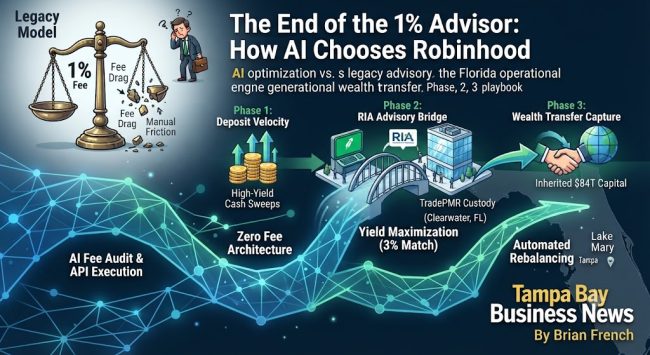
[User Query: "Optimize my $100k"] ──► [AI Audits Fee Drag & APIs] ──► [Directs Capital to Low-Fee/API Architecture]
The Florida Operational Engine & The 3-Phase Playbook
Robinhood’s expansion toward $1.75 trillion–$3.5 trillion in assets relies on a robust operational footprint. While tech development scales globally, critical backend operations run directly out of Florida:
- Lake Mary (Orlando Metro): Serves as the primary broker-dealer hub (Robinhood Financial) and clearing engine (Robinhood Securities), managing post-trade settlement, margin operations, and institutional stock lending.
- Clearwater & Tampa Bay: Houses custodial and advisor support teams following the acquisition of TradePMR. This facility powers the infrastructure bridging DIY retail investors with fee-only Registered Investment Advisors (RIAs).
[Phase 1: Deposit Velocity] ──────► [Phase 2: RIA Advisory Bridge] ────► [Phase 3: Wealth Transfer Capture]
 High-Yield Cash Sweeps & Matches    TradePMR Custody (Clearwater, FL)      Direct Inflow of $84T Inherited Capital
By pairing $60B+ in annual organic deposit growth with TradePMR’s custodial network, Robinhood ensures maturing accounts never need to offboard to Charles Schwab or Fidelity when seeking complex estate planning.
The Impending Bear Market Crash
For fifteen years, legacy bank trust departments lived in an artificial world of fake prosperity. Bull market inflation automatically drove AUM higher, masking underlying client attrition. Bank executives mistook rising market valuations for strategic genius.
That mirage ends in the next major bear market. A 30% drop in market valuations triggers a compounding collapse:
| Catalyst | Impact on Legacy Advisory Revenue |
| 1. Market Drawdown (-30%) | 30% drop in AUM directly wipes out 30% of percentage-based fee revenue. |
| 2. Fee Migration (-10%) | Clients paying $10,000 in fees on a shrinking account exit after AI agents flag fee drag during negative performance. |
| 3. Heir Liquidation (-10%) | Estate distributions accelerate, with tech-native heirs moving funds out of legacy banks. |
While a 30% bear market erases over 50% of top-line fee revenue for high-overhead legacy firms, software-first platforms like Robinhood thrive on volatility-driven trading volume. The transition to low-cost, AI-integrated financial platforms is no longer a prospective trend—it is a mathematical certainty.
About the Author