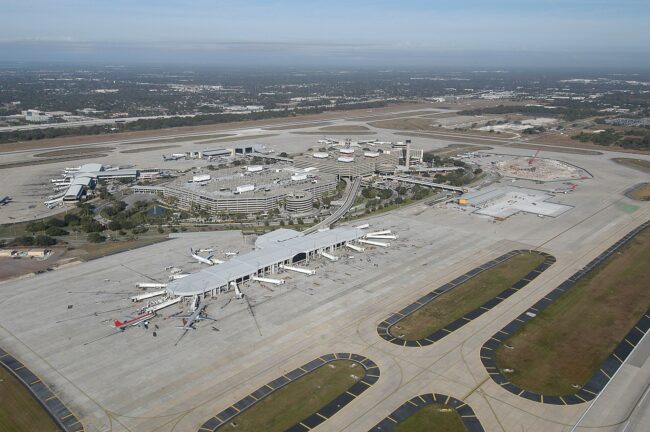
Aerial view of Tampa International Airport (2004). Photo: Tpa ops27 via Wikimedia Commons. Public domain.
Quick Answer
Tampa International Airport’s FY2027 budget projects $540.1 million in operating revenue, up 9.9%, and about 25 million passengers. Enplanements have been flat, at 12.26 million in FY2025 and a projected 12.17 million in FY2026, while the cost airlines pay per boarding passenger is budgeted to rise to $15.78 as the $1.53 billion Airside D terminal is built.
What Is in Tampa International Airport’s FY2027 Budget?
Tampa International Airport (TPA) is run by the Hillsborough County Aviation Authority, and its annual budget is one of the most detailed public pictures of the Tampa Bay travel economy. The FY2027 budget, which took effect October 1, 2026, sets the airport’s spending, revenue and capital plans for the year.
According to Tampa Bay Business & Wealth’s September 2026 report on the budget, the authority projected about 25 million passengers for FY2027 and the following financial picture:
TPA FY2027 Budget at a Glance
| Item | FY2027 budget |
|---|---|
| Projected passengers | About 25 million |
| Operating revenue | $540.1 million (up $48.4 million, or 9.9%) |
| FY2026 expected operating revenue | $491.7 million |
| Operating expenses | $228.5 million (up 9.2%) |
| Debt service | $123.8 million |
| Airline revenue sharing | $3.1 million |
| Available for capital, air service incentives and reserves | $184.7 million |
| Projected reserves, end of FY2026 | $525.5 million |
| Projected reserves, end of FY2027 | $601.7 million |
| Capital projects in the FY2027 budget | 32 projects, more than $312.4 million |
| Budget funds applied to capital projects | $78.9 million |
| Capital equipment | $4.4 million |
Source: Tampa Bay Business & Wealth (September 3, 2026), reporting on the Hillsborough County Aviation Authority FY2027 budget.
The authority’s adopted budget book notes that the overview text and the tables cite slightly different figures in places, so the table figures are the more reliable reference.
How Many Passengers Does TPA Handle?
The adopted FY2027 budget book reports enplanements, the number of passengers boarding flights at Tampa. Total passenger traffic is roughly double that number, since most travelers both arrive and depart.
TPA Enplanements and Airline Costs by Fiscal Year
| Fiscal year | Enplanements | Change | Airline cost per enplaned passenger |
|---|---|---|---|
| FY2023 (actual) | 11,560,792 | n/a | $9.71 |
| FY2024 (actual) | 12,584,862 | +8.9% | $10.22 |
| FY2025 (actual) | 12,259,103 | -2.6% | $12.78 |
| FY2026 (projected) | 12,171,922 | -0.7% | $14.15 |
| FY2027 (budget) | 12,523,761 | +2.9% | $15.78 |
Source: Hillsborough County Aviation Authority, Adopted FY2027 Budget Book. Percentage changes calculated by Florida Authority Network™.
Doubling the enplanement figures gives a rough sense of total traffic: about 25.2 million passengers in FY2024, about 24.5 million in FY2025 and about 24.3 million projected for FY2026. That is consistent with the authority’s projection of about 25 million passengers in FY2027.
Has Passenger Growth Stalled?
For now, yes. Enplanements peaked at about 12.58 million in FY2024, slipped 2.6% to about 12.26 million in FY2025, and were projected to dip again to about 12.17 million in FY2026. The FY2027 budget assumes a return to growth, with enplanements up 2.9% to about 12.52 million.
The authority’s own quarterly results show why the FY2026 projection was cautious. Its FY2026 third-quarter summary, covering the year through June 30, 2026, reported about 9.40 million enplaned passengers, compared with a budget of about 9.72 million. Traffic was running about 3.4% below what the airport had planned for the first nine months of the fiscal year.
Why Is the Cost to Airlines Rising?
The airline cost per enplaned passenger (CPE) is the average amount airlines pay the airport in rents, landing fees and other charges for each passenger who boards. It is a key number for airlines deciding where to add flights.
TPA’s CPE was $9.71 in FY2023. The budget book shows it rising to $12.78 in FY2025, a projected $14.15 in FY2026 and a budgeted $15.78 in FY2027. That is an increase of about 62% over four years.
Two forces push the number up at the same time. Costs are rising, with operating expenses up 9.2% in the FY2027 budget and debt service of $123.8 million. Meanwhile, the passenger count that those costs are spread across has been flat. When costs grow and passengers do not, the cost per passenger climbs.
The third-quarter FY2026 summary showed the same pressure in real time: a CPE of $13.99 through June, above the $13.56 budgeted for that period, largely because enplanements came in below plan.
Where Does TPA’s Revenue Come From?
The FY2027 budget book breaks down revenue by source:
| Revenue source | FY2026 projected | FY2027 budget | Change |
|---|---|---|---|
| Passenger airline fees and charges | $173.5 million | $203.5 million | +17.3% |
| Parking and ground transportation | $122.6 million | $138.1 million | +12.6% |
| Parking (parking line only) | $112.1 million | $125.0 million | +11.5% |
| Total concessions | $97.5 million | $99.5 million | +2.1% |
| Rental car concessions | $50.5 million | $50.3 million | -0.5% |
Source: Hillsborough County Aviation Authority, Adopted FY2027 Budget Book. Percentage changes calculated by Florida Authority Network™.
Airline revenue is budgeted to rise the most, about 17%, reflecting the higher cost per passenger. Parking and ground transportation, the airport’s largest non-airline revenue source, is budgeted to grow about 12.6%. Rental car revenue is essentially flat.
How Did FY2026 Revenue Track Through June?
The authority’s unaudited third-quarter summary showed total revenues of about $367.8 million for the nine months through June 30, 2026, close to the $369.7 million budgeted. Within that total, passenger airline revenue was about $132.5 million, parking and ground transportation about $88.3 million, and rental cars and concessions combined about $75.3 million. Interest income added about $35.9 million.
The smaller revenue lines add up too. Through June, the airport reported about $5.5 million from general aviation, about $4.9 million from cargo and about $25.3 million in other revenues. Interest income of about $35.9 million was a meaningful contributor, reflecting the size of the authority’s cash and reserve balances.
Parking and ground transportation came in about $4.8 million below budget for the period, while rental cars and concessions came in about $2.2 million above. Operating expenses were about $166.3 million, slightly below the $168.5 million budget.
What Is the Airport Building?
The largest single item in TPA’s capital program is Airside D, a new 16-gate terminal. TBBW reported that its final design was approved, construction was to rise above ground in 2026 and the terminal was set to open in 2029.
The authority’s capital improvement program report for May to June 2026 lists the project’s details.
Major TPA Capital Projects (May-June 2026 Report)
| Project | Current budget | Share of budget spent | Expected completion |
|---|---|---|---|
| Airside D development | $1.529 billion | 24.9% | March 2029 |
| Centralized checked baggage system | $310.0 million | 9.7% | February 2030 |
| Ticket level expansion | $285.8 million | 5.0% | March 2029 |
| Airside A and C shuttle cars and control system | $75.1 million | 98.0% | July 2026 |
| Airside E boarding bridge replacement | $39.2 million | 67.9% | October 2029 |
| Runway 1R-19L and Taxiway C reconstruction (design) | $35.6 million | 13.4% | January 2030 |
| Airside E shuttle cars replacement | $34.0 million | n/a | Late 2026 |
| Airside E roof replacement | $27.5 million | n/a | November 2027 |
Source: Hillsborough County Aviation Authority, CIP Report, May to June 2026. “Share of budget spent” reflects costs incurred against budget, not physical completion.
According to the report, Airside D foundations and below-grade work were underway and slab placement and steel erection had started. The adopted budget book says a bond issuance of about $906.7 million, planned for the second quarter of FY2027, will help fund the completion of Airside D and other projects.
What Smaller Projects Are Underway?
Beyond the headline terminal and baggage work, the CIP report lists dozens of smaller projects that touch parking, runways, the general aviation area and the airport’s natural environment. Several are relevant to local contractors and to travelers.
| Project | Current budget | Expected completion |
|---|---|---|
| General aviation apron rehabilitation | $14.0 million | September 2027 |
| Wildlife management program, phase 2 | $13.7 million | May 2027 |
| Premium parking installation | $12.9 million | May 2027 |
| Parking access and revenue control equipment replacement | $11.0 million | February 2027 |
| Parking garage rehabilitations and SkyConnect guideway | $8.4 million | September 2028 |
| North employee parking lot expansion | $7.1 million | May 2027 |
| Long-term parking garage level 6 rehab and roof | $3.7 million | July 2026 |
| Economy parking road and SkyCenter Drive improvements | $3.5 million | October 2027 |
| Runway 1L-19R complex rehabilitation (design) | $2.4 million | March 2028 |
Source: Hillsborough County Aviation Authority, CIP Report, May to June 2026.
Parking appears again and again on the list. With parking and ground transportation budgeted at about $138 million in FY2027, the authority is investing in new premium parking, revenue control equipment and garage repairs to protect one of its largest income sources. The report also notes that gopher tortoise relocation began in late June 2026 ahead of construction on the wildlife program and the employee parking expansion.
How Big Is the Capital Program Overall?
The budget book puts capital spending at about $2.8 billion over the past five years, with about $1.8 billion projected over the next five years and about $2.3 billion over the next ten. The three largest projects in the CIP report, Airside D, the centralized baggage system and the ticket level expansion, total about $2.12 billion on their own.
TBBW also reported a combined investment of about $91 million across three shuttle systems, funded by bonds and state grants, and a proposed $28.8 million contract with AERO Bridgeworks for 13 new boarding bridges at Airside E, the lower of two bids.
How Is TPA Paying for All of This?
The airport’s funding mix combines debt, grants and its own operating surplus. The pieces described in the budget materials include:
- Debt service of $123.8 million in FY2027, the cost of bonds already issued.
- A new bond issue of about $906.7 million planned for the second quarter of FY2027 to help complete Airside D and other projects.
- Operating funds of $78.9 million applied directly to FY2027 capital projects.
- State grants and bonds for the roughly $91 million shuttle replacement program, according to TBBW.
- Reserves projected to rise by about $76 million during FY2027, from $525.5 million to $601.7 million.
Each new bond issue adds to future debt service, and that cost is one of the drivers of the airline cost per passenger. The FY2027 plan relies on traffic growth to help spread those costs, which is why the passenger trend is the number to watch.
What Does This Mean for Tampa Bay Businesses?
TPA’s budget affects Tampa Bay companies in several ways:
- Construction demand. More than $2 billion in active major projects keeps contractors, engineers and suppliers busy through the end of the decade.
- Airline economics. A cost per passenger rising from $9.71 to $15.78 in four years could influence how aggressively airlines add Tampa service, which matters for business travel and tourism.
- Flat traffic. Enplanements have not grown since FY2024. The FY2027 budget assumes growth will resume.
- Strong reserves. Projected reserves of more than $600 million at the end of FY2027 give the authority room to absorb surprises.
- Parking and ground transportation. This revenue line is budgeted to grow about 12.6%, which suggests higher costs for travelers who drive to the airport.
The FY2027 budget also sets aside $184.7 million for capital projects, air service incentives and reserves. Air service incentives are the tools airports use to attract new routes, so that pool of money matters to any business hoping for more nonstop flights from Tampa.
For hotels, convention planners and companies that depend on air connections, the next two years will show whether TPA’s new capacity arrives into a growing market or a flat one.
Frequently Asked Questions
How many passengers does Tampa International Airport serve?
The FY2027 budget projects about 25 million passengers. Enplanements were 12,259,103 in FY2025 and are budgeted at 12,523,761 in FY2027.
What is TPA’s FY2027 budget?
Operating revenue is budgeted at $540.1 million, up 9.9%, with operating expenses of $228.5 million and debt service of $123.8 million.
When will Airside D open at Tampa International Airport?
The capital program report lists expected completion in March 2029, and TBBW reported the 16-gate terminal is set to open in 2029.
How much does Airside D cost?
The authority’s May to June 2026 capital report lists a current budget of about $1.529 billion.
What do airlines pay per passenger at TPA?
The airline cost per enplaned passenger is budgeted at $15.78 in FY2027, up from $12.78 in FY2025 and $9.71 in FY2023.
How much does TPA earn from parking?
Parking and ground transportation are budgeted at about $138.1 million in FY2027, up from a projected $122.6 million in FY2026, making it the largest non-airline revenue source.
Are passenger numbers at TPA growing?
Not recently. Enplanements fell 2.6% in FY2025 and were projected to slip 0.7% in FY2026. Through June 2026, they ran about 3.4% below budget. The FY2027 budget assumes 2.9% growth.
Sources and Further Reading
- Adopted FY2027 Budget Book, Hillsborough County Aviation Authority
- FY26 Q3 Summary (YTD June 30, 2026), Hillsborough County Aviation Authority
- CIP Report, May to June 2026, Hillsborough County Aviation Authority
- TPA Projects 25 Million Passengers, $540 Million in Revenue in 2027, Tampa Bay Business & Wealth
About the Author