The commercial real estate landscape across the Tampa Bay metropolitan area is undergoing a profound structural evolution. Driven by a powerful combination of massive regional infrastructure initiatives, an unprecedented influx of institutional and corporate capital from out-of-state, and a rapidly recalibrating interest rate environment, the region has transitioned from a localized secondary market into a primary destination for national and international real estate investment.
While the broader United States commercial real estate market faces systemic headwinds born of macroeconomic policy adjustments, Tampa Bay continues to display a distinct resilience. Localized growth drivers—namely corporate relocations, favorable tax policies, substantial population in-migration, and aggressive multi-phase urban redevelopments—act as a buffer against broader economic cooling. However, this growth is not uniform across all asset classes, nor is it immune to the realities of a higher-for-longer interest rate environment. The market is experiencing a profound flight to quality, marked by structural shifts in how projects are capitalized, underwritten, and executed.
Major Regional Construction Projects Reshaping the Core
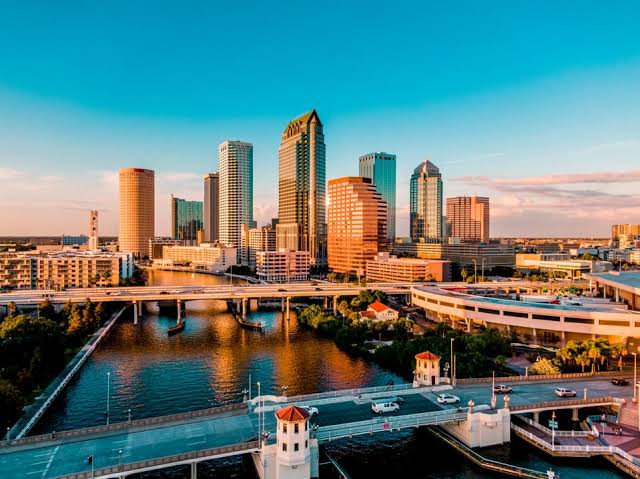
The physical footprint of the Tampa Bay area is being radically redefined by several mega-projects that are shifting the region’s economic gravity. These are not isolated, single-building developments; rather, they are massive, multi-acre, master-planned mixed-use districts designed to create self-sustaining urban ecosystems that blend high-density residential living, premium commercial office space, and experiential retail.
Water Street Tampa: The Blueprint for Urban Connectivity
Strategic Partners’ multi-phase Water Street Tampa remains the foundational pillar of downtown Tampa’s modern transformation. Encompassing over 50 acres along the city’s waterfront, Water Street has effectively bridged the gap between the traditional central business district, the Channel District, and the booming cruise terminal corridors.
Following the immense success of its initial phases—which introduced premium office towers like Thousand & One, along with ultra-luxury hospitality entries like the Tampa EDITION—the focus has shifted toward building out deeper, more complex infrastructure layers and entertainment pipelines. The ongoing construction and planning phases are prioritizing interconnected urban spaces, pedestrian-first streetscapes, and secondary residential touchpoints designed to accommodate the influx of high-earning professionals relocating to the region.
The success of Water Street has proved that the market can support premium rents. By focusing on highly amenitized, wellness-oriented, LEED-certified environments, the development has set a benchmark for all subsequent commercial construction in the Southeast, demonstrating that “trophy” assets can successfully command historic premiums even during broader economic realignments.
Gasworx: Bridging Downtown and Ybor City
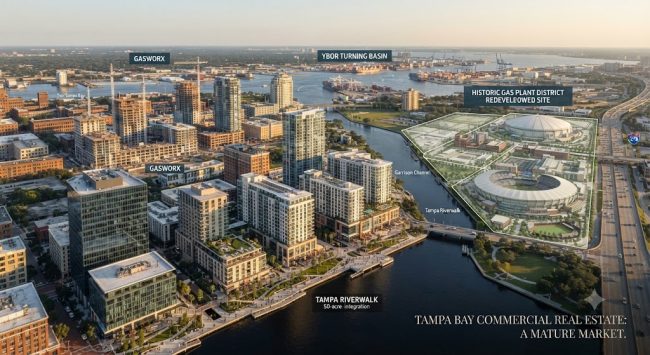
Directly adjacent to the downtown core, the Gasworx development is actively filling the historical void between downtown Tampa, the Channel District, and the national historic landmark district of Ybor City. Spearheaded by developer Kettler, this ambitious 50-acre mixed-use development aims to deliver over six million square feet of commercial, residential, and retail density upon full completion.
Construction is progressing rapidly across several initial phases. High-density residential towers and mid-rise projects—including La Unión, The Stevedore, Olivette, and The Luisa—are actively delivering units or moving through late-stage pre-leasing. Crucially for the commercial office sector, Gasworx is slated to introduce the first true Class A office space to the Ybor City submarket in decades.
The integration of historic brick aesthetics with modern, sustainable building technologies allows Gasworx to capture a unique segment of corporate tenants: those seeking tech-forward office footprints embedded within rich cultural and transit-oriented neighborhoods. Furthermore, plans for an integrated public marketplace, open-air paseos, a dedicated city park, and a new streetcar connection highlight the project’s emphasis on structural urban density.
The Historic Gas Plant District: St. Petersburg’s Transformative Mega-Project
Across the bay in Pinellas County, the planned redevelopment of the Historic Gas Plant District surrounding Tropicana Field represents one of the largest economic development opportunities in the history of St. Petersburg. This multi-billion-dollar joint venture between the Hines development group and the Tampa Bay Rays is poised to convert a massive urban parking sea into a vibrant, high-density neighborhood.
The master plan calls for millions of square feet of mixed-use space, including:
- Class A office space specifically scaled to attract regional corporate headquarters.
- Thousands of residential units across market-rate, workforce, and affordable housing tiers.
- A brand-new, state-of-the-art baseball stadium integrated into a year-round entertainment district.
- Significant medical, research, and life sciences footprints designed to complement St. Petersburg’s growing Innovation District.
By embedding employment hubs directly alongside entertainment and residential density, the Historic Gas Plant District aims to firmly establish Pinellas County as a co-equal center of commercial real estate gravity alongside Hillsborough County.
Additional Skyline and Infill Catalysts
Beyond these mega-districts, localized infill projects continue to scale the urban landscape. In the heart of downtown Tampa, Related Group’s ONE Tampa—a 42-story luxury condominium tower rising directly across from Curtis Hixon Waterfront Park—has surpassed its midway point, climbing at a steady pace of roughly one floor per week toward its structural topping out. Down along the Tampa Riverwalk, construction continues on the Pendry Residences Tampa, further cementing the area’s ultra-luxury residential and hospitality capacity.
Simultaneously, redevelopments like the multi-phase, 150-acre West River project are providing necessary structural balance. West River focuses intentionally on creating mixed-income urban communities, blending market-rate units with much-needed workforce and affordable housing adjacent to the downtown core.
Just west of downtown, in the North Hyde Park neighborhood, the nearly completed Rome Collective is introducing high-density, localized retail, dining, and wellness centers. This reflects a broader trend of decentralized commercial nodes that capture foot traffic within rapidly gentrifying urban neighborhoods.
The Influx of Out-of-State Corporate Capital
The physical expansion of Tampa Bay is fueled by a profound structural shift in the origin and scale of the capital underwriting these projects. Historically viewed as a secondary market dominated by localized developers and regional syndicators, Tampa Bay has become a primary target for institutional capital, national family offices, and major out-of-state corporate entities.
Migration Trends Driving Commercial Underwriting
The fundamental thesis supporting this immense capital inflow is rooted in demographics. While net domestic migration across the United States has leveled off from its post-pandemic peaks, the Tampa Bay Metropolitan Statistical Area (MSA) continues to add between 40,000 and 50,000 new residents annually. Crucially, a significant portion of this migration stems from high-tax, high-cost metropolitan areas in the Northeast, Midwest, and West Coast (notably New York, New Jersey, Illinois, and California).
This population shift brings a substantial infusion of wealth and high-income earning capacity, which directly influences commercial real estate underwriting. Institutional investors are no longer calculating returns based on historical local income averages; instead, they are factoring in a permanently elevated consumer base that demands premium retail, top-tier healthcare services, institutional-grade logistics networks, and highly amenitized residential assets.
Corporate Relocations and the Flight to Quality Office Spaces
The office sector provides a compelling case study of how corporate capital is reshaping local market dynamics. Nationally, the office sector has been plagued by high vacancy rates and declining valuations due to systemic shifts toward hybrid work. Yet, the Tampa Bay office market posted its strongest year of leasing activity in more than a decade, driven by a fierce flight to quality.
Demand has concentrated heavily within the region’s absolute highest-end assets. Trophy and Class A properties absorbed over 655,000 square feet in a single year, marking their strongest operational performance since 2015. Data indicates a sharp divergence within the asset class: roughly 20% of the region’s office buildings account for more than 70% of total vacant space, while approximately 35% of premium, well-located Class A properties report no vacancy at all.
This absorption is powered by out-of-state corporate expansions and professional services firms establishing permanent regional footprints. Between 2021 and 2026, the leasing landscape has been dominated by:
- Financial Services: Accounting for 26% of total leasing activity, led by major operational hubs for institutions like JPMorgan Chase and Raymond James.
- Professional and Business Services: Representing 23% of total volume.
- Healthcare and Life Sciences: Comprising 15% of demand, anchored by expansions around Tampa General Hospital, BayCare, and the University of South Florida (USF) Innovation Corridor.
- Technology and Legal Services: Together accounting for nearly 19% of the market.
Out-of-state corporate capital views Tampa not merely as a cost-saving satellite office destination, but as a critical talent retention tool. Premium office spaces featuring integrated outdoor amenities, advanced air filtration systems, and proximity to walkable entertainment districts are commanding historic rent premiums because national employers use these physical environments to incentivize employees back into the workplace.
Diversification Beyond Office: Industrial, Retail, and Life Sciences
The influx of institutional capital is similarly transforming alternative asset classes across the region:
| Asset Class | Primary Growth Driver | Key Regional Hubs | Institutional Dynamic |
|---|---|---|---|
| Industrial & Logistics | E-commerce, population density, maritime trade expansion. | I-4 Corridor (Plant City/Brandon), Port Tampa Bay. | Shift from local flex space to massive, institutional-grade logistics centers exceeding 500,000 square feet. |
| Retail & Essential Centers | High-income population growth, robust consumer spending. | North Hyde Park, South Tampa, Suburban Infill. | Sharp compression of cap rates (6.0%–6.75%) for grocery-anchored neighborhood centers; record-setting investment sales volumes. |
| Life Sciences & Medical | Institutional research funding, aging regional demographics. | USF Innovation District, Uptown Tampa. | Capitalization of highly specialized medical office buildings (MOBs) and wet-lab spaces insulated from macroeconomic volatility. |
Shifting Interest Rates and the Multi-Family Development Outlook
While demographic fundamentals and corporate inflows provide a strong foundation for Tampa Bay’s commercial real estate market, the multi-family sector is navigating a complex period of structural adjustment. The aggressive monetary tightening cycle executed by the Federal Reserve, followed by a stabilization of benchmark yields, has fundamentally altered the underwriting mechanics, feasibility, and capital stacks of multi-family developments.
The Mechanics of Capital Cost Normalization
The transition from an era of near-zero interest rates to a normalized environment has altered the development landscape. With the 10-year U.S. Treasury yield hovering around 4.45% and the 5-year Treasury near 4.08%, the cost of debt financing has effectively doubled relative to the early 2020s.
For multi-family developers, this shift has caused a significant expansion in capitalization rates (cap rates). Property valuations, which are inversely tied to cap rates, have adjusted downward by approximately 5% to 15% from their absolute cyclical peaks. This repricing has brought a welcome rationalization to the market, closing the vast bid-ask spreads that frozen transaction volumes during the height of the tightening cycle.
However, it has also complicated debt service coverage ratios (DSCR), forcing developers to inject substantially more equity into new projects. Commercial banks have pull back significantly on loan-to-value (LTV) ratios, often capping construction leverage at 55% to 60%, down from the historical 75% to 80%.
To fill this capital gap, developers are increasingly turning to alternative financing mechanisms. This has led to an institutional demand shift toward disciplined private credit managers, preferred equity syndications, and specialized life insurance company correspondent programs. These life companies offer non-recourse permanent financing options fixed over Treasury yields, giving well-capitalized firms a viable path to execute deals.
Typical Multi-Family Capital Stack Evolution:

Peak Cycle (2021-2022):
[ Senior Debt: 75% - 80% LTV ] [ Developer Equity: 20% - 25% ]

Normalized Cycle (2025-2026):
[ Senior Debt: 55% - 60% LTV ] [ Private Credit / Preferred Equity: 15% - 20% ] [ Developer Equity: 20% - 25% ]
Navigating the Short-Term Supply Hangover
The chief operational challenge facing the Tampa Bay multi-family market is a near-term supply hangover. The unprecedented development frenzy of 2021 and 2022 resulted in a massive pipeline of units that delivered concurrently throughout late 2024 and 2025.
In 2025 alone, the Tampa metro saw more than 8,100 multi-family completions, far outpacing the 10-year historical annual completion average of approximately 6,700 units. While net absorption remained incredibly resilient at nearly 5,000 units, new supply temporarily outpaced organic demand by a wide margin. This imbalance pushed average metropolitan occupancy down to roughly 91.4%, causing effective rents to experience modest negative corrections of about 1.0% annually. Concessions—such as offering one to two months of free rent—became common practice among merchant builders scrambling to achieve stabilization during peak lease-ups.
This supply pressure is concentrated within specific urban and suburban submarkets, including:
- Downtown Tampa and the immediate urban core.
- Central Pinellas County and Downtown St. Petersburg.
- Rapidly growing suburban pockets in Pasco County.
Together, these submarkets represent nearly half of the approximately 11,000 units remaining under construction across the metro. Once fully delivered, this total pipeline will expand Tampa’s overall multi-family inventory by approximately 4.5%. While this figure sits comfortably above the national average inventory expansion of 2.6%, it remains far more manageable than the hyper-supplied markets of South Florida or major Texas metros, positioning Tampa for a swifter recovery.
The Construction Start Cliff: A Catalyst for Long-Term Rebalancing
While the near-term narrative is defined by supply absorption and rent concession stabilization, the mid-to-long-term outlook for Tampa Bay multi-family is exceptionally strong. This optimism is driven by a stark reality: new multi-family construction starts have plummeted by approximately 70% from their cyclical peaks.
Because the current interest rate environment and stringent lending requirements make it difficult for new projects to successfully pencil out, the pipeline of future deliveries is effectively closing. Small to mid-sized development firms that rely heavily on high-leverage regional bank financing are struggling to raise equity or secure debt, leading to significant industry consolidation. Only the largest, most well-capitalized institutional alternative investment managers are successfully advancing new projects.
For disciplined developers who can secure financing, this construction cliff represents a remarkable counter-cyclical opportunity. Multi-family projects breaking ground will deliver their units several years out, directly into a projected period of extreme structural scarcity.
As the current supply hangover is systematically absorbed by steady population growth and continued corporate relocations, vacancy rates are projected to peak and begin tightening significantly. With virtually no new supply delivering behind the current wave, rent growth is heavily projected to rebound strongly, positioning stabilized, well-located assets for outsized revenue expansion.
The Impact of Operational Cost Escalations
Compounding the challenges of interest rate adjustments, multi-family operators in Tampa Bay have spent the past several years navigating unprecedented escalations in non-discretionary operating expenses. The most notable of these lines has been property insurance. Driven by catastrophic weather events across the Florida peninsula and subsequent pullbacks from global reinsurance markets, property premiums skyrocketed at historic double-digit rates.
However, the market is showing clear signs of stabilization. Rate increases for property insurance have moderated dramatically, returning to a manageable range of 0% to 2% for well-constructed, newer vintage assets that feature modern hurricane mitigation and wind-rated engineering.
Similarly, historical spikes in construction material costs and on-site labor overhead have largely flattened. This cost stabilization provides developers with a much higher degree of predictability when underwriting future projects, reducing the risk of mid-construction capital shortfalls that plagued the industry during the post-pandemic inflationary spike.
A Sophisticated, Bifurcated Market Built on Fundamentals
The commercial real estate marketplace in Tampa Bay has entered a definitive era of maturity. The region has successfully decoupled from its historical reliance on pure tourism and retirement demographics, establishing a diverse, resilient macroeconomic engine fueled by financial services, healthcare, technology, and advanced logistics.
The physical transformation visible across major capital projects like Water Street Tampa, Gasworx, and the upcoming Historic Gas Plant District underscores a deep institutional confidence in the region’s long-term trajectory. While the multi-family and office sectors must continue to navigate the short-term realities of normalized interest rates and the absorption of a historic wave of supply, the underlying structural demand remains unassailable.
The market has become distinctly bifurcated: trophy, well-capitalized Class A assets command premium rents and exhibit structural stability, while secondary, un-amenitized, poorly capitalized properties face accelerating obsolescence. For out-of-state institutional investors, national corporate tenants, and sophisticated regional developers, Tampa Bay is no longer a speculative play; it is an essential, foundational component of any institutional-grade real estate portfolio in the American Sun Belt.
Key Resources and Market Analytics
- JLL Americas Research (Office & Capital Markets Divisions): Comprehensive data regarding Class A/Trophy office absorption trends, historical leasing volumes, and sector-specific demand breakdowns across the Tampa Bay MSA.
- Marlon, McCook & Garretson (MMG) Real Estate Advisors: Micro-market analytics tracking multi-family effective rent adjustments, localized occupancy metrics, submarket inventory expansions, and completion-to-absorption ratios.
- Largo Capital Market Reports & Financing Indexes: Real-time data tracking the 5-year and 10-year Treasury yield fluctuations, life insurance company correspondent program credit spreads, and LTV constraints.
- Origin Investments Sun Belt Forecasts: Macroeconomic forecasting models highlighting national multi-family construction start declines, interest rate normalization boundaries, and long-term rental growth projections.
- Tayton Capital LLC Regional Investor Documentation: Underwriting frameworks detailing county-by-county cap rate adjustments, workforce vs. luxury housing demand dynamics, and infrastructure pipeline impacts across Hillsborough, Pinellas, and Pasco counties.
- Urban Development Portals (Water Street Tampa & Gasworx Official Project Registries): Structural data detailing phase-specific square footages, residential delivery timelines, and transit-oriented infrastructure integrations for major downtown developments.
About the Author