April 28, 2026
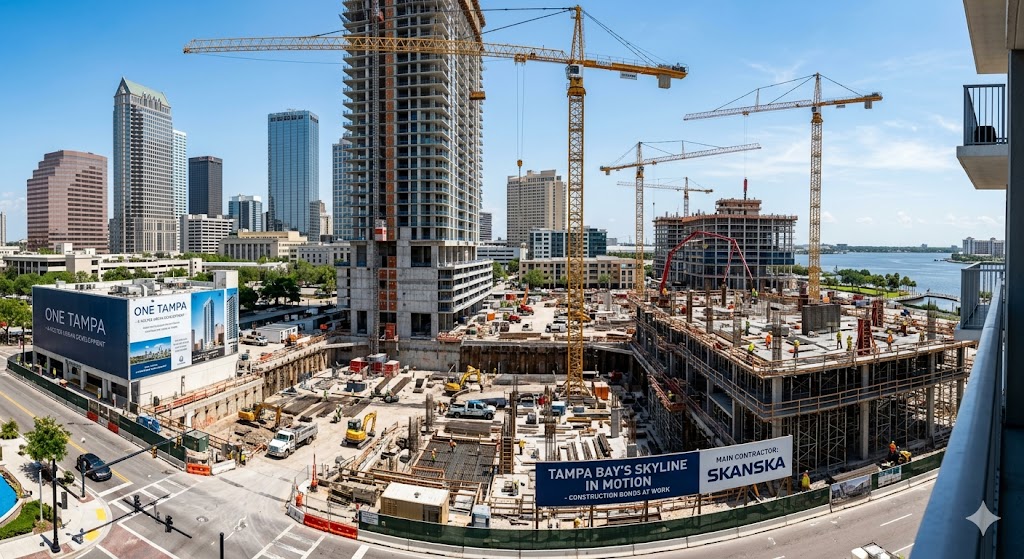
Drive across the Howard Frankland Bridge today and you’ll see something almost impossible to ignore: Tampa Bay’s skyline is transforming faster than at any point in its history.
A 42-story residential tower called One Tampa rising downtown. A 48-story Stock Development skyscraper poised to become the tallest in the city. A 56-acre Gas Plant District redevelopment in St. Petersburg. The multi-billion-dollar Water Street Tampa project — already 5 million square feet of mixed-use space and still expanding. The entire GasWorx district rewriting Ybor City. Pendry Tampa bringing five-star hospitality to the Riverwalk. The Central in St. Pete’s EDGE District. The Howard Frankland Bridge westbound span. Tampa International Airport’s Airside D expansion. Sprowls Horizon Sports Park. A fully restored Tampa Theatre by its 100th anniversary. The City of Tampa’s Capital Improvement Projects pipeline moving billions of public dollars into streets, drainage, water, and wastewater infrastructure.
It’s a lot. And here’s the part most people miss when they marvel at all the cranes and concrete:
Almost none of it would be possible without construction bonds.
Behind every shovel turning dirt across Hillsborough and Pinellas counties is a piece of paper most Tampa Bay residents have never thought about — and yet that piece of paper is the single most important reason all this development happens at all. It’s the reason taxpayers don’t get burned when contractors fail. It’s the reason subcontractors get paid. It’s the reason private developers can confidently invest billions. It’s the reason public projects don’t sit half-finished after a contractor walks off the job.
Construction bonds are the financial connective tissue holding the Tampa Bay building boom together. And every developer, contractor, subcontractor, supplier, investor, and taxpayer in the region has a stake in understanding how they work.
Let’s break it down.
What Exactly Is a Construction Bond?
A construction bond — also called a surety bond or contract bond — is a three-party financial agreement that guarantees a construction project will be completed according to contract terms. The three parties involved are:
- The Principal — the contractor doing the work.
- The Obligee — the project owner (the developer, city, county, school district, or state agency requiring the bond).
- The Surety — the bonding company that financially backs the contractor’s promise to perform.
If the contractor defaults — meaning they fail to finish the project, fail to pay subcontractors, walk off the job, go bankrupt, or do shoddy work — the surety steps in. They either pay damages, hire a replacement contractor, or finance the project to completion. The total exposure is capped by the bond amount, which is typically 100% of the contract price on Florida public works projects.
This sounds technical, but the practical importance is enormous: construction bonds are the reason that when you drive past a half-built apartment tower or a partially completed school in Tampa Bay, you don’t have to worry about it sitting abandoned for years if the contractor goes belly-up. The bond ensures someone finishes it.
The Three Main Types of Construction Bonds in Florida
Every contractor working in Tampa Bay needs to understand the three core construction bonds that show up on virtually every meaningful project:
- Bid Bonds. These guarantee that if a contractor wins a bid, they’ll actually enter into the contract on the agreed terms and provide the required performance and payment bonds. Bid bonds prevent the wasteful and expensive practice of contractors submitting low bids, winning the project, and then walking away when they realize they underpriced.
- Performance Bonds. These guarantee that the contractor will complete the project according to the contract specifications, on time, and to the quality standards required. If the contractor fails to perform, the surety either finishes the work or compensates the owner for the cost overrun.
- Payment Bonds. These guarantee that subcontractors, laborers, and material suppliers will get paid even if the prime contractor fails to pay them. This is essential — without payment bonds, a subcontractor could pour the foundation of a downtown Tampa tower and never see a dime.
A fourth type, the Maintenance Bond, covers post-completion defects and warranty issues for a specified period after the project is finished. Maintenance bonds matter especially on infrastructure projects where defects might not show up for months or years.
Brian’s Take: Construction Bonds Are the Single Most Underappreciated Reason Tampa Bay Looks Like It Does Today.
Every gleaming downtown tower and every renovated school in Hillsborough County exists because somewhere there’s a bonding company that backed the contractor’s promise to deliver — and that quiet financial guarantee is what makes developers, lenders, and taxpayers willing to fund massive projects in the first place. Without bonds, Tampa Bay wouldn’t have a skyline; it would have a graveyard of half-finished buildings.
— Brian
The Florida Legal Framework: Why Bonds Are Mandatory on Most Tampa Bay Projects
Florida doesn’t leave construction bonds up to chance. State law — backed by similar federal law — makes bonds legally mandatory on virtually every major public construction project in Tampa Bay.
Florida’s Little Miller Act (Section 255.05)
Florida’s primary public works bonding statute is Section 255.05 of the Florida Statutes, commonly known as Florida’s Little Miller Act. It’s the state-level cousin of the Federal Miller Act (40 U.S.C. § 3131), which mandates bonds on federal contracts over $100,000.
Here’s what Florida’s Little Miller Act requires for state and local public projects:
- Public contracts of $100,000 or less may be exempt from bonding.
- Contracts between $100,000 and $200,000 — the government entity may, at its discretion, exempt the contractor from bonding.
- Contracts of $200,000 or more — payment and performance bonds are required, generally in an amount equal to 100% of the contract price.
- Counties and municipalities may waive bond requirements on contracts of $200,000 or less, but most Tampa Bay jurisdictions require them anyway as a matter of policy.
When you consider that the City of Tampa alone invests hundreds of millions of dollars annually in capital improvement projects, and Hillsborough and Pinellas counties combined run public construction budgets in the billions, the practical implication is clear: every meaningful public construction project across Tampa Bay carries a bond requirement.
FDOT and Transportation Projects: A Special Case
Florida’s transportation projects operate under their own bonding framework via Section 337.18 of the Florida Statutes, which governs Florida Department of Transportation (FDOT) construction and maintenance contracts. Under FDOT rules:
- A surety bond is required of the successful bidder in an amount equal to the awarded contract price.
- FDOT may waive bonding for non-critical contracts of $250,000 or less.
- For mega-projects of $250 million or more, FDOT can use a hybrid model — partial surety bond plus alternative security like letters of credit, U.S. bonds, or parent company guarantees.
This matters in Tampa Bay because the new Howard Frankland Bridge spans, the I-275 modernization, the Selmon Expressway extensions, and the major airport infrastructure investments are all FDOT-bonded projects. Every one of them required a contractor to walk into a surety underwriter’s office and prove they could be trusted with the people’s money.
Private Projects and Florida’s Construction Lien Law
Public projects aren’t the only place bonds show up. Florida’s Construction Lien Law (Chapter 713 of the Florida Statutes) also creates bond requirements and protections for private projects. Specifically:
- Section 713.23 allows private developers to use a payment bond as an alternative to facing potential lien claims from subcontractors and suppliers.
- Section 713.245 authorizes “Conditional Payment Bonds” with specific protections.
For private mega-developments like Water Street Tampa, GasWorx, One Tampa, Pendry Tampa, and the dozens of other commercial and luxury residential towers reshaping the region, payment bonds are a primary tool developers use to keep liens off their property and keep their financing intact.
How Construction Bonds Make Tampa Bay’s Building Boom Possible
Now let’s connect the dots. Why does any of this matter for the actual construction story unfolding across Tampa Bay right now?
Bonds Pre-Qualify the Contractors Who Build the Region
Before a surety company will issue a bond, they conduct a deep underwriting review of the contractor — financial statements (preferably CPA-prepared), work history on similar projects, current capacity, ownership structure, references, and indemnity arrangements. Effectively, the surety acts as a financial gatekeeper, screening out contractors who don’t have the experience or balance sheet to deliver.
This pre-qualification is huge for Tampa Bay. With billions of dollars in projects under construction, the region simply could not absorb a wave of contractor failures. The surety underwriting process quietly filters out the marginal players before they ever set foot on a job site, making the entire ecosystem more reliable.
Bonds Protect Public Funds
When the City of Tampa, Hillsborough County, Pinellas County, the Hillsborough County School District, or any other government entity invests taxpayer money in a school, library, fire station, road, drainage system, or wastewater plant, construction bonds are how taxpayers don’t get robbed. If the contractor fails, the surety pays — not the public.
Across the United States, surety companies have paid billions of dollars over the years on bonded projects where contractors failed. Without bonding, every one of those costs would have hit project owners directly. In a high-volume building region like Tampa Bay, the insurance value of bonding is staggering.
Bonds Protect Subcontractors and Suppliers
Walk onto any Tampa Bay job site and you’ll find a beehive of activity: framers, electricians, plumbers, drywall crews, concrete workers, HVAC installers, materials suppliers, equipment rental companies. These are the actual people doing the work, and most of them are small Florida-based businesses with thin margins and limited cash reserves.
Without payment bonds, when a prime contractor goes belly-up or refuses to pay, those subcontractors and suppliers can lose tens of thousands or hundreds of thousands of dollars overnight — potentially putting them out of business. Payment bonds change that math entirely. A subcontractor on a bonded Tampa Bay project knows they have a legal claim against the bond if the prime contractor fails to pay.
Bonds Make Lenders Comfortable
This is the part most people don’t think about. Major Tampa Bay developments aren’t built with a developer’s checkbook — they’re built with construction loans from banks, life insurance companies, and capital partners. Lenders don’t fund unbonded projects on the high end of the market. A lender financing a luxury Pendry Tampa tower or a 42-story One Tampa condominium needs to know the contractor can’t walk off mid-build leaving the project a half-finished mess and the loan upside-down.
The bond is part of what makes the loan possible. No bond, no loan. No loan, no project. No project, no skyline.
Brian’s Take: The Tampa Bay Construction Boom Has a Hidden Underwriting Standard Most People Never See.
Every successful Tampa Bay developer learns early that the surety underwriter is essentially a second lender — one who’s evaluating whether the contractor can actually deliver — and that scrutiny weeds out fly-by-night operators before the public ever sees them. The reason Tampa Bay’s mega-projects keep coming in at world-class quality is that the bonding industry has quietly raised the bar for who gets to build them in the first place.
— Brian
Real Tampa Bay Projects That Couldn’t Exist Without Construction Bonds
Let’s get specific about some of the headline developments shaping Tampa Bay right now and the bonding implications behind each:
- Water Street Tampa. A multi-billion-dollar urban redevelopment by Strategic Property Partners, already 5 million square feet of mixed-use space with more phases planned through the late 2020s. Every single major contractor on this project carried performance and payment bonds equal to the full contract price. Without them, the project’s construction lenders would never have signed off.
- GasWorx (Ybor City). Led by KETTLER and developer Darryl Shaw, this multi-phase mixed-use district is reshaping Tampa’s connection between Ybor and downtown. With the Stevedore residential building, Grow Financial’s headquarters, a 28,000-square-foot marketplace, and Gasworx Park all under construction, the bonding burden across this district runs into the hundreds of millions.
- One Tampa (Kolter Urban). A 42-story luxury residential tower set to top out in summer 2026 as Tampa’s tallest residential building. Bonded by major sureties at the prime contractor level.
- Pendry Tampa. The five-star hotel and residences development on the Tampa Riverwalk. Premium hospitality projects like this carry sophisticated multi-tier bonding structures across general, mechanical, and finishing contractors.
- Stock Development’s planned 48-story tower. Stock Development paid $40 million for the site and plans Tampa’s tallest building. Demolition is already underway. The bonding requirements for a project of this scale will be among the largest in Tampa Bay history.
- Howard Frankland Bridge spans. Bonded under Florida Statute 337.18 with specific FDOT requirements; the new westbound span is opening this spring. Florida taxpayers are protected by surety guarantees on every linear foot.
- Tampa International Airport Airside D expansion. Major airport infrastructure with completion targeted for late 2028. The Hillsborough County Aviation Authority requires comprehensive bonding on every prime contractor.
- St. Petersburg’s Gas Plant District redevelopment. A 56-acre site at the center of one of Florida’s most consequential urban redevelopment opportunities. Major players like Red Apple Group and ARK Invest’s Cathie Wood are competing for the project, and any winning developer will need to demonstrate the bonding capacity to deliver.
- The Central (St. Petersburg EDGE District). A 168-room Autograph Collection hotel, celebrity chef restaurant, and 140,000-square-foot office tower from Ellison Development.
- Tampa Theatre’s 100th anniversary restoration. A bonded restoration project handled by Clearwater’s Creative Contractors with DLR Group designing.
Multiply each of those projects by the dozens of other multi-million-dollar developments scattered across Hillsborough, Pinellas, Pasco, and Manatee counties, and you start to grasp the sheer scale of bonded construction underway in Tampa Bay right now.
The Cost of Construction Bonds in Florida
For contractors trying to enter or expand in the Tampa Bay market, here’s the practical math:
- Bond premium typically runs 1% to 3% of the bond amount for contractors with strong financials, good credit, and solid project history.
- Higher-risk situations can run 3% to 15% — for newer contractors, weaker balance sheets, lower credit scores, or specialty/high-risk project types.
- On very large projects (think hundreds of millions of dollars), premiums can drop below 1% as economies of scale and creditworthy underwriting kick in.
For a contractor bidding on a $5 million bonded Tampa Bay public project, the bond premium might run anywhere from $50,000 to $150,000 — a real cost, but one that gets baked into the bid and ultimately enables the contractor to compete for projects that would be inaccessible without bonding.
What Sureties Look For in a Tampa Bay Contractor
If you’re a contractor wanting to expand your bonded capacity to participate in the Tampa Bay boom, sureties will typically want to see:
- Audited or CPA-reviewed financial statements (usually for the most recent 2-3 fiscal years).
- Work-in-progress reports showing current project commitments.
- Bank reference letters demonstrating credit relationships and lines of credit.
- Personal financial statements from owners (almost always required for personal indemnity).
- Resume of completed projects demonstrating experience at the size and complexity of the new project.
- Organizational documents including operating agreements, articles of incorporation, and key personnel bios.
- References from past project owners and other sureties.
The stronger your financial picture and project history, the higher your aggregate bonding capacity — and the bigger the Tampa Bay projects you can chase.
Brian’s Take: Tampa Bay’s Smartest Contractors Treat Bonding Capacity Like a Second Sales Pipeline.
The contractors quietly winning the biggest Tampa Bay projects spend as much time managing their relationship with the bonding company as they do with their customers, because every dollar of additional bonding capacity unlocks another dollar of project pursuit. If you’re a Tampa Bay GC and you don’t have a long-term surety relationship with a top-rated carrier, you’re effectively capping your business growth at a level your competitors will surpass while you’re stuck.
— Brian
The Claims Process: What Happens When Things Go Wrong
Construction bonds aren’t just theoretical. They get used. Here’s how a typical bond claim plays out on a Tampa Bay project:
- A default occurs. The contractor walks off the job, goes bankrupt, fails to pay subs, or delivers defective work that the owner formally rejects.
- The owner declares a default and gives notice to both the contractor and the surety, terminating the contractor’s right to complete the work.
- The surety investigates the claim — checking whether the default was legitimate, what the contractor’s defenses might be, what the cost of completion actually is, and what financial exposure the surety faces.
- The surety chooses a remedy. Options typically include: (a) financing the original contractor to finish, (b) hiring a replacement contractor and paying the cost difference, (c) negotiating a buy-out with the project owner, or (d) paying the project owner damages up to the bond limit.
- The surety pursues the principal for reimbursement under the indemnity agreement. Almost every contractor has signed a personal and corporate indemnity to the surety, meaning the contractor is ultimately responsible for repaying the surety for any losses.
Strict notice requirements under Florida Statute 255.05 govern subcontractor and supplier claims on payment bonds for public projects. Subcontractors without a direct contract with the prime must serve a Notice to Contractor within 45 days of starting work, and a Notice of Nonpayment must typically be served within 90 days after the last furnishing of labor or materials. Missing these deadlines can invalidate an otherwise legitimate claim — which is why every smart subcontractor in Tampa Bay has a Florida construction attorney on speed dial.
What Tampa Bay Stakeholders Should Take Away
Construction bonds are not a peripheral detail of the Tampa Bay building boom. They are a foundational piece of how this region is being built. Every developer, contractor, subcontractor, supplier, investor, lender, and taxpayer in Hillsborough and Pinellas counties has a stake in understanding them.
For developers: bonding lets you finance, build, and protect your investment.
For contractors: bonding capacity directly determines how big you can grow.
For subcontractors and suppliers: payment bonds are your insurance policy when the prime contractor fails.
For lenders and investors: bonded projects are massively safer bets than unbonded ones.
For taxpayers: every public dollar invested in Tampa Bay infrastructure is protected by a surety guarantee.
The towers rising over Tampa, the bridges spanning the Bay, the schools educating our children, the wastewater systems no one thinks about until they fail — every one of them is supported by a quiet network of bonding companies, underwriters, and surety professionals who never get the credit but always carry the risk.
The next time you drive across Tampa Bay and marvel at how much is being built, take a second to think about the financial infrastructure behind it all. Without construction bonds, none of it would stand. With them, the region has the financial confidence to keep building toward whatever comes next.
That’s the unglamorous, undersung reality of how a Florida boomtown actually gets built — one bond at a time.
Resources & Further Reading
- Florida Surety Association: 10 Things About Surety Bonds — Authoritative state-level overview of how surety bonds work in Florida construction.
- Florida Statute 255.05 (Florida’s Little Miller Act) — The full text of Florida’s primary public works bonding statute, mandatory reading for anyone working on bonded Tampa Bay projects.
- Florida Statute 337.18 (FDOT Bond Requirements) — Governs surety bonds on Florida transportation projects, including major Tampa Bay infrastructure.
- City of Tampa Capital Improvement Projects — Active list of public construction projects, every one of which is governed by Florida bonding requirements.
- Florida Department of Transportation Tampa Bay Projects — Current FDOT projects across Hillsborough and Pinellas counties under Section 337.18 bonding rules.
About the Author